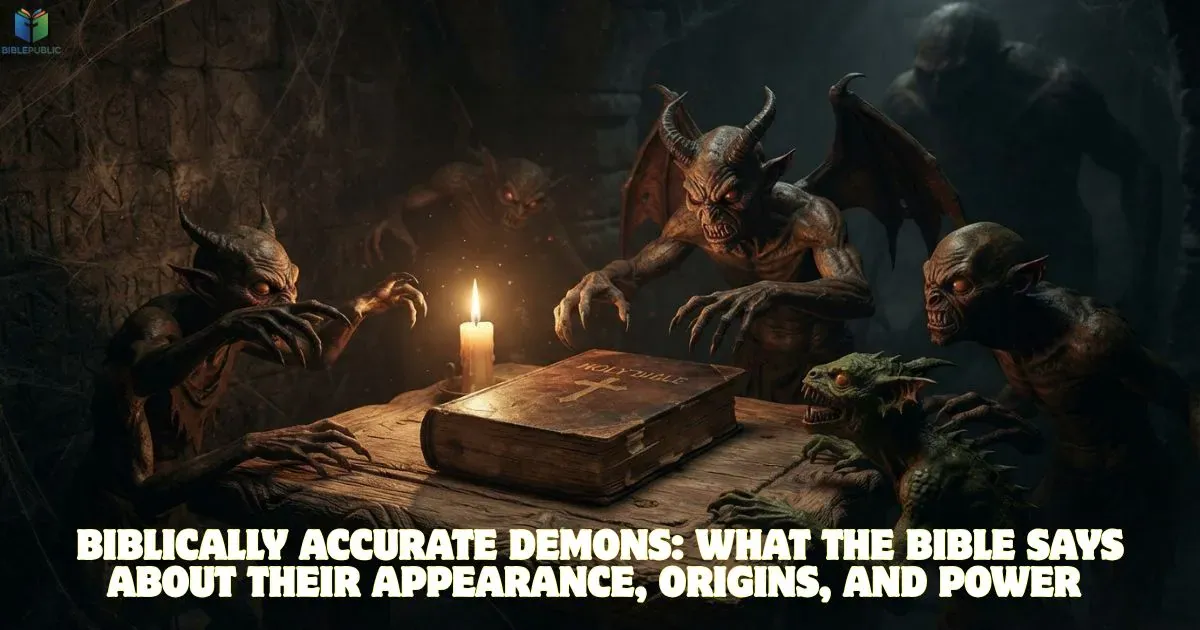
When people imagine demons, they often picture horns, scary faces, and dark figures. But what are Biblically Accurate Demons really like? The Bible describes evil spirits in several ways, yet it does not give one complete physical description of every demon. Understanding these passages helps separate biblical teachings from popular beliefs.
This article explores what Scripture says about demons, their possible origins, names, and power. You’ll learn how demons differ from Satan and fallen angels, how Jesus responded to evil spirits, and what the Bible teaches about spiritual warfare. Along the way, we’ll distinguish clear biblical statements from interpretations that remain uncertain.
What Are Biblically Accurate Demons?
The phrase biblically accurate demons is a modern expression people use when looking for descriptions of demons based on the Bible rather than movies, games, or fantasy art. It is not a formal biblical category, and Scripture does not provide one complete visual design that represents every demon.
In the New Testament, demons are commonly associated with unclean spirits and are described through their interactions with people. In several Gospel accounts, Jesus commands unclean spirits to leave individuals, demonstrating his authority over them (Mark 1:23–27; Luke 8:26–33).
The Bible also discusses Satan, rebellious spiritual beings, and evil spiritual influences. However, these references should not automatically be treated as descriptions of the same being or as proof that every spiritual creature has a particular appearance.
To understand biblical descriptions accurately, it is important to consider each passage in its original context. Some texts describe events in narrative form, while others use poetry, prophecy, or apocalyptic imagery. These different literary forms affect how readers should interpret the language.
What Do Demons Look Like According to the Bible?
The Bible does not give a single, consistent physical portrait of demons. Most passages about demons focus on their actions, influence, or encounters with Jesus rather than their faces, bodies, skin, or clothing.
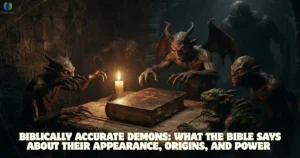
This means that images of demons with horns, hooves, red skin, or large bat-like wings should not automatically be described as direct biblical depictions. Artists may use these features to communicate evil or fear, but the Bible does not establish them as the standard appearance of demons.
Does the Bible Describe the Physical Appearance of Demons?
In most biblical accounts, demons are identified by what they do rather than by how they look. For example, Mark 1:23–27 describes an unclean spirit reacting to Jesus in a synagogue. Jesus commands the spirit to come out, and the people are amazed by his authority.
Luke 8:26–33 describes a man who is tormented by demons and Jesus commanding the spirits to leave him. The passage gives details about the man’s condition and the spirits’ actions, but it does not provide a standard physical description of demons.
These accounts do not mean that every biblical passage uses the same language or that all Christians interpret the subject identically. They show that the main emphasis in these narratives is spiritual conflict and Jesus’ authority, not demon anatomy.
When creating or evaluating a biblical illustration, it is therefore more accurate to distinguish details explicitly stated in Scripture from artistic choices added to communicate a particular mood.
What Are the Se’irim in the Old Testament?
The Hebrew term se’irim is associated with goats or goat-like beings, but its precise meaning depends on the biblical context. It appears in passages that discuss Israel’s religious practices and descriptions of desolate places.
In Leviticus 17:7, the Israelites are warned not to offer sacrifices to the se’irim. Isaiah 13:21 and Isaiah 34:14 use related language in descriptions of deserted places. Bible translations differ in how they render these passages, with some using terms connected to goats, wild creatures, or spiritual beings.
These references have led to different interpretations of the term. Some readers understand it as referring to goat-like spirits, while others emphasize its connection with forbidden worship or imagery associated with desolate places.
However, these passages do not provide a complete physical description of demons. The term se’irim should be understood within each passage rather than treated as proof that all demons have goat-like bodies, horns, or hooves.
What Do the Locusts in Revelation 9 Represent?
The vision in Revelation 9:1–11 describes locust-like creatures emerging from the smoke of the Abyss. Their appearance is unusual and frightening, with features that include something like crowns, human faces, hair, teeth, and armor.
Because this passage contains supernatural imagery and refers to the angel of the Abyss, some readers connect the creatures with demonic forces. Others interpret the vision symbolically, as imagery associated with judgment or destructive powers.
The passage describes these creatures within John’s vision. It does not state that every demon has this appearance or establish a universal physical form for demons.
Revelation is an apocalyptic book that uses vivid imagery to communicate its message. Its descriptions should be studied within the wider context of the vision rather than treated automatically as literal biological details.
Are Biblical Descriptions of Demons Literal or Symbolic?
The answer depends on the passage. The Bible contains historical narratives, poetry, prophetic visions, parables, and apocalyptic writing. Each form communicates meaning differently.
For example, the Gospel accounts describe Jesus encountering unclean spirits in narrative settings. Revelation 9, by contrast, presents extraordinary creatures within an apocalyptic vision. Readers should not assume that these passages use imagery in exactly the same way.
Christians also differ in how they interpret some supernatural passages. Some emphasize a more literal reading, while others understand particular details as symbolic or as a combination of literal events and symbolic meaning.
A careful approach begins by asking what the passage actually says, what literary form it uses, and what its surrounding context contributes. It is also important to admit when Scripture does not provide enough information to reach a firm conclusion.
Where Do Demons Come From According to the Bible?
The Bible refers to demons and unclean spirits, but it does not present one detailed, universally accepted account of their origin. Several passages discuss rebellious spiritual beings, and later Jewish writings expand on these themes.
Some Christian traditions connect demons with fallen angels. Other discussions draw on ancient Jewish interpretations of Genesis 6 and the Nephilim. These explanations should be distinguished from statements that the biblical text makes explicitly.
What Does the Bible Say About the Nephilim?
Genesis 6:1–4 mentions the “sons of God,” the daughters of humans, and the Nephilim. The passage says that the Nephilim were on the earth in those days and describes mighty figures associated with the ancient world.
The identity of the “sons of God” has been interpreted in several ways. Some interpreters understand them as rebellious heavenly beings, while others understand them as human groups or rulers. The passage has a long history of debate.
Importantly, Genesis 6 does not explicitly say that the Nephilim became demons after death. That idea belongs to a particular interpretive tradition rather than to a direct statement in the passage.
Readers should therefore distinguish between what Genesis says, how later Jewish writings develop the story, and how different Christian traditions explain the origin of evil spirits. This distinction helps avoid presenting a debated interpretation as an undisputed biblical fact.
What Does 1 Enoch Teach About Demons?
First Enoch, also called 1 Enoch, is an ancient Jewish religious work that expands on themes associated with Genesis 6. In the Book of the Watchers, rebellious heavenly beings, giants, and the activity of harmful spirits are connected in an account that offers one explanation for the origin of demons.
In this tradition, the spirits associated with the dead giants become harmful spirits on earth. This explanation helps readers understand how some ancient Jewish writers interpreted the relationship between Genesis 6, rebellious heavenly beings, and evil spirits.
However, 1 Enoch is a separate work from Genesis, and its teachings should not automatically be attributed to every biblical tradition. It is not included in the biblical canons used by most Protestant and Catholic churches, but it is part of the biblical canon of the Ethiopian Orthodox Tewahedo Church.
For this reason, it is important to distinguish what Genesis explicitly says from how 1 Enoch develops the story. First Enoch provides valuable historical context for studying ancient Jewish beliefs, but its account should be identified as a particular religious interpretation rather than a teaching accepted by all Christians.
What Does the Bible Clearly State, and What Remains Uncertain?
The New Testament describes demons and unclean spirits in several accounts of Jesus’ ministry. Mark 1:23–27 and Luke 8:26–33 describe encounters in which Jesus commands unclean spirits or demons to leave people. Ephesians 6:10–18 also discusses spiritual opposition and the need for believers to stand firm in their faith.
Other questions receive less direct explanation. The Bible does not provide one detailed account of the origin of every demon, explicitly identify all demons as fallen angels, or state that the Nephilim became demons after death. These ideas appear in various interpretations and religious traditions, but they should not be presented as direct statements from Genesis or the New Testament.
A careful study separates three things: what a passage directly says, what readers infer by comparing biblical passages, and what later religious writings teach. This approach allows readers to explore different interpretations without confusing them with established details in the biblical text.
When a passage leaves a question unanswered, acknowledging that uncertainty is more accurate than claiming the Bible provides a definite answer.
What Names and Terms Does the Bible Use for Demons?
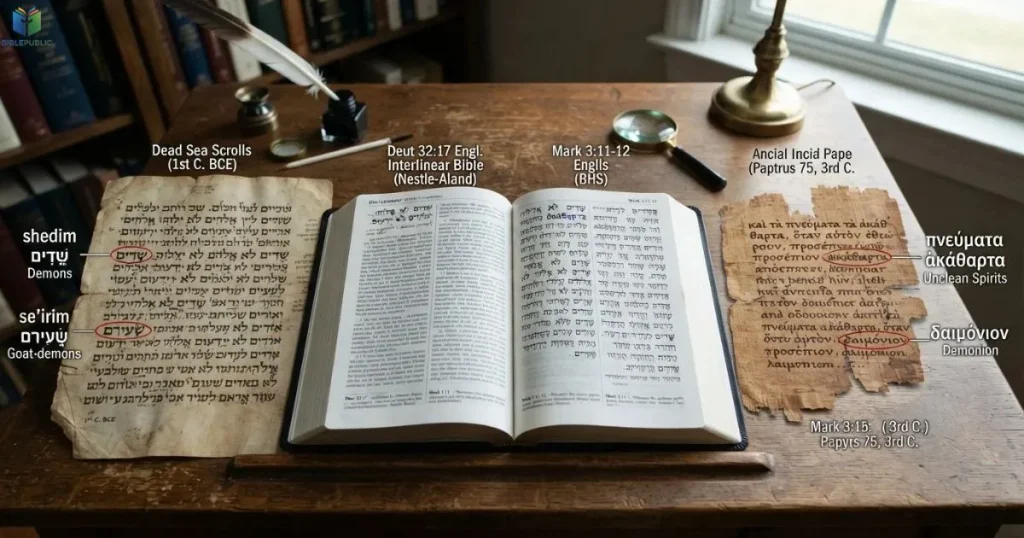
Biblical passages use several Hebrew and Greek words when discussing spiritual beings, idols, and unclean spirits. These words do not always mean the same thing, so they should be interpreted in context rather than combined into one list of interchangeable demon names.
Understanding the original terms can help readers see why different English Bible translations sometimes use different wording.
What Do the Hebrew Terms Shedim and Se’irim Mean?
The Hebrew term shedim appears in Deuteronomy 32:17 and Psalm 106:37, where it is associated with sacrifices offered to beings other than God. Many English Bible translations render shedim as “demons.”
The term se’irim appears in Leviticus 17:7 and in descriptions of desolate places in Isaiah 13:21 and 34:14. Its meaning and translation vary by context, with interpretations connecting it to goats, goat-like beings, or spiritual entities.
Although both terms appear in discussions of Israel’s religious practices and other spiritual beings, they should not automatically be treated as synonyms. Each word needs to be understood in its own passage and literary setting.
These Hebrew terms also do not establish a standard physical appearance for all demons. To understand their meaning more precisely, readers should compare Bible translations and consult reliable Hebrew lexicons or biblical commentaries.
What Do Daimonion and Unclean Spirits Mean in the New Testament?
The Greek word daimonion is commonly translated as “demon,” while the expression “unclean spirit” is another frequent New Testament description. These terms appear in Gospel accounts of Jesus confronting spiritual opposition.
For example, Mark 1:23–27 describes an unclean spirit in a synagogue, and Luke 8:26–33 describes a man associated with many demons. In these accounts, Jesus commands the spirits and demonstrates authority over them.
The terms overlap in the New Testament’s descriptions of spiritual beings, but readers should still pay attention to the language of each passage. A word’s meaning is shaped by how it is used, not merely by the existence of a similar term elsewhere.
The New Testament’s main concern in many of these accounts is what Jesus does and what his authority reveals. It does not offer a complete classification system covering every possible kind of spiritual being.
What Do Azazel and Abaddon Mean in Their Biblical Contexts?
Azazel appears in Leviticus 16, which describes the Day of Atonement ritual. Two goats are presented before the Lord. One is designated for a sin offering, while the other is sent into the wilderness after the Israelites’ sins are symbolically placed upon it (Leviticus 16:7–10, 20–22).
The exact meaning of Azazel has been debated. Some interpretations connect the term with the wilderness destination, while others understand it as referring to a personal or spiritual being. Leviticus 16 does not provide enough detail to identify Azazel confidently as a demon in the same sense as the demons described in the New Testament.
Abaddon appears in a different context. In Job 26:6 and Proverbs 15:11, the term is associated with destruction or the realm of the dead. In Revelation 9:11, Abaddon is the name given to the angel of the Abyss, with Apollyon as its Greek equivalent.
These passages should be understood separately. Azazel’s role in the Day of Atonement ritual differs from Abaddon’s role in Revelation. Neither term should automatically be treated as another name for Satan or as a general name for every demon.
What Is the Difference Between Demons, Fallen Angels, and Satan?
The Bible discusses demons, Satan, and rebellious spiritual beings, but it does not provide one complete chart explaining every relationship among them. Christian traditions have developed different ways of connecting these passages.
A careful reading distinguishes what the text identifies directly from what interpreters conclude by comparing passages. This is especially important when discussing fallen angels and the origin of demons.
How Does the New Testament Describe Demons and Unclean Spirits?
The New Testament presents demons and unclean spirits as spiritual opponents who can afflict people. In the Gospels, Jesus commands them to leave individuals, and the accounts emphasize his authority over them (Mark 1:23–27; Luke 8:26–33).
These accounts do not provide a complete explanation of the origin or hierarchy of every spiritual being. They describe particular encounters and their significance within Jesus’ ministry.
The terms “demons” and “unclean spirits” are closely connected in many New Testament passages, but readers should avoid inventing detailed categories that the text does not establish. The emphasis is on the spiritual conflict described and Jesus’ authority over it.
What Does the Bible Say About Fallen Angels?
Several New Testament passages refer to angels who sinned or abandoned their proper place. Second Peter 2:4 speaks of angels who sinned, while Jude 6 describes angels who did not keep their proper position. These passages provide important context for understanding what the Bible says about fallen angels and their rebellion.
However, neither passage fully explains the origin of demons or explicitly establishes that all demons are fallen angels. Some Christian traditions identify them with fallen angels, while other interpretations draw on ancient Jewish writings such as 1 Enoch. These views should be distinguished from what Scripture directly states.
What Are Satan’s Biblical Names and Titles?
The Bible uses several names and titles associated with Satan. Their meanings should be understood within the passages where they appear, rather than treated as a list of interchangeable names for every evil spirit.
- Satan: The name is associated with the idea of an adversary or accuser. In Matthew 4:1–11, Satan tempts Jesus in the wilderness.
- The devil: This title is used in the New Testament for the spiritual opponent who tempts and opposes God’s purposes.
- The tempter: Matthew 4:3 uses this description during the account of Jesus’ temptation.
- The evil one: This expression appears in passages such as Matthew 6:13 and 1 John 5:19. The precise reference in a particular verse should be considered in context.
- The dragon and the ancient serpent: Revelation 12:9 identifies the great dragon and ancient serpent with the devil and Satan within its apocalyptic vision.
- Lucifer: This name is traditionally associated with Satan in some Christian interpretations. However, Isaiah 14:12 appears in a passage whose immediate context addresses the king of Babylon. Later Christian interpretation has connected this language with Satan’s fall, a debated subject in discussions of the biblical origins and fall of Satan.
These terms do not mean that Satan and demons are the same being. The Bible portrays Satan as a distinct figure, while other passages describe demons and unclean spirits. Understanding each title in context helps avoid confusing biblical statements with later interpretations.
How Powerful Are Demons According to the Bible?
Biblical accounts portray demons as capable of causing serious distress, but they do not present evil spiritual powers as equal to God. The Bible’s broader message is that God remains sovereign and that Jesus exercises authority over demons.
The text also warns readers against evil, temptation, and spiritual opposition. It does not encourage people to become fascinated with demons or to treat speculation about them as more important than faithfulness to God.
What Does the Bible Say About Satan’s Power and Limitations?
The Bible portrays Satan as an adversary who tempts, deceives, and opposes God’s purposes. In Matthew 4:1–11, Satan tempts Jesus in the wilderness, but Jesus resists by responding with Scripture.
Other passages describe limits on Satan’s activity. In Job 1–2, Satan’s actions occur within boundaries established in the narrative. James 4:7 instructs believers to submit to God and resist the devil. First Peter 5:8–9 warns believers to remain alert and stand firm in their faith.
These passages do not suggest that Satan has unlimited power or rules independently over the universe. They present spiritual opposition as real within the biblical worldview while emphasizing God’s authority and the responsibility of believers to remain faithful.
Christians differ in how they interpret some details about spiritual powers. Nevertheless, the biblical passages above do not support treating Satan as God’s equal.
How Did Jesus Demonstrate Authority Over Demons?
The Gospels repeatedly describe Jesus confronting demons and unclean spirits. In Mark 1:23–27, Jesus commands an unclean spirit to come out of a man, and the people are astonished by his authority. In Luke 8:26–33, Jesus commands a group of demons to leave a man in the region of the Gerasenes.
These accounts present Jesus’ authority as greater than the spirits’ power. They also show that the stories are about more than frightening supernatural events: they reveal Jesus’ identity and the significance of his ministry.
The accounts should be read in their full biblical context. They do not give readers permission to diagnose other people, assume that every illness has a spiritual cause, or attempt dangerous rituals based on speculation.
The central emphasis is Jesus’ authority and the restoration of people who were suffering.
How Did Popular Culture Shape the Image of Demons?
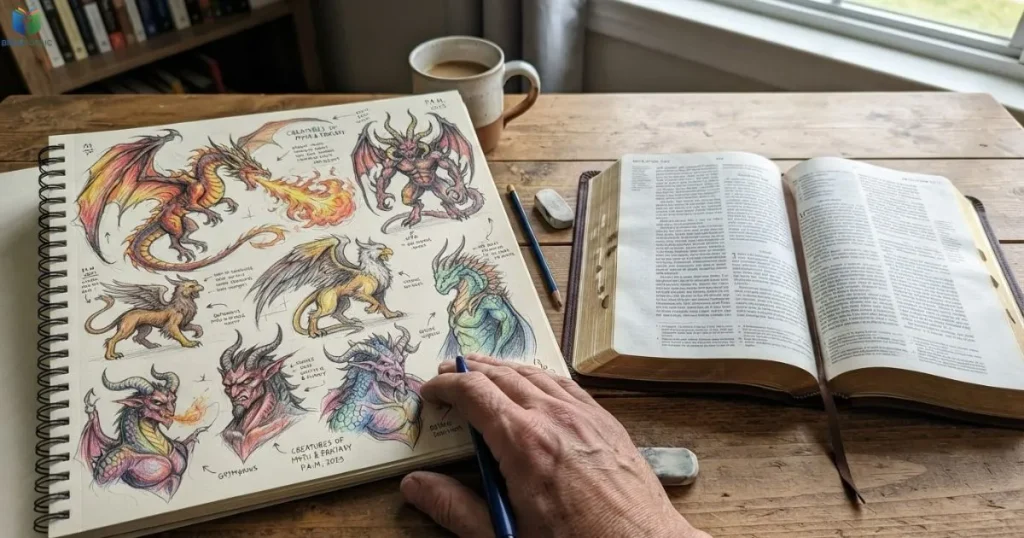
Modern movies, video games, books, and artwork often portray demons with horns, hooves, wings, sharp teeth, or pitchforks. These familiar images can influence how people imagine biblical evil spirits, even though Scripture does not give one standard physical description of all demons.
Religious art, folklore, literature, and entertainment have all contributed to popular images of evil. To understand whether a particular depiction is biblically accurate, readers should compare its features with the relevant passages rather than assume that a familiar design comes directly from Scripture.
How Did Horns, Hooves, and Pitchforks Become Associated With Demons?
The Bible does not describe all demons as having horns, hooves, and pitchforks. These familiar features belong to a wider history of religious art, folklore, literature, and cultural storytelling rather than to one complete biblical description.
Some biblical passages use language associated with goats or goat-like beings. However, those references do not establish horns and hooves as the standard appearance of demons. Likewise, the pitchfork is a familiar cultural symbol, not a physical feature that Scripture assigns to demons.
Artists and storytellers have used recognizable features to represent danger, rebellion, or evil. Repeated use of these images has helped shape modern expectations of what demons should look like.
When evaluating an image as biblically accurate, ask which specific passage supports each feature. If the text does not describe a particular detail, it is more accurate to identify it as an artistic interpretation rather than a direct biblical fact.
Does the Bible Say Satan Rules Hell?
The Bible does not describe Satan as the sovereign ruler of hell in the way popular culture often portrays him. This familiar image is largely a cultural representation rather than a straightforward biblical teaching.
Matthew 25:41 refers to eternal fire prepared for the devil and his angels. Revelation 20:10 describes the devil being thrown into the lake of fire and sulfur, where judgment is carried out against him. These passages portray Satan as subject to judgment, not as the independent king of a realm where he rules over the dead.
The Bible uses several terms and images when discussing judgment, death, and the final fate of evil. These concepts should not automatically be treated as identical in every passage. Still, the idea that Satan rules hell as its triumphant monarch is not what these verses say.
Understanding this distinction helps separate biblical teaching from popular images that developed in art, literature, and entertainment.
Can Christians Be Demon Possessed?

Christians differ in how they understand demonic possession and whether biblical accounts describe experiences that can occur today. The New Testament records people being affected by demons or unclean spirits, but Christian traditions interpret the relationship between these accounts and modern experiences in different ways.
Any discussion of possession should take Scripture seriously without encouraging fear or unsupported accusations. Unusual behavior, seizures, emotional distress, and mental health symptoms do not prove that a person is possessed. Such experiences can have medical or psychological causes and deserve appropriate professional assessment and care.
What Do Biblical Accounts Say About Demonic Possession?
The Gospels describe people affected by demons or unclean spirits. In Mark 5:1–20, Jesus encounters a man living among the tombs who is described as having an unclean spirit. Luke 8:26–33 records a related account involving demons in the region of the Gerasenes.
These narratives describe the individuals’ suffering and Jesus’ response. They emphasize his authority over the spirits and the restoration of people who were suffering.
Christians differ over how these accounts should be applied to experiences today. The passages do not justify assuming that someone has a demon because they behave unusually, experience seizures, or struggle with mental illness. Medical and psychological concerns should be assessed by qualified professionals.
How Do Christians Interpret Spiritual Opposition Today?
Many Christians understand spiritual opposition through themes such as temptation, deception, suffering, and the challenge of remaining faithful to God. They differ in how much emphasis they place on direct demonic activity today.
Some traditions practice prayers of deliverance under pastoral guidance. Others focus on prayer, Scripture, worship, community support, and resisting temptation. These approaches vary among Christian denominations and communities.
Whatever their tradition, Christians should avoid using spiritual explanations to shame or frighten people who are suffering. Prayer and pastoral care can accompany appropriate medical or mental health treatment rather than replace it. A careful biblical approach encourages wisdom, compassion, and faith instead of panic.
What Does the Bible Teach About Spiritual Warfare?
The New Testament describes spiritual warfare as a struggle involving faithfulness to God, resistance to evil, and perseverance in the face of spiritual opposition. Ephesians 6:10–18 presents the armor of God as a way for believers to stand firm.
This passage does not encourage obsession with demons or speculation about their appearance. It emphasizes spiritual readiness, truth, righteousness, faith, salvation, God’s word, and prayer.
What Is the Meaning of the Armor of God in Ephesians 6?
Ephesians 6:10–18 uses the image of armor to explain how believers can stand firm against spiritual opposition. The passage names several pieces of armor, each connected with a quality or resource important to Christian life.
- The belt of truth: Believers are called to live in truth rather than deception.
- The breastplate of righteousness: Righteousness represents a life shaped by what is right before God.
- The shoes of the gospel of peace: The image points to readiness connected with the good news of peace.
- The shield of faith: Faith helps believers remain steadfast when facing spiritual challenges.
- The helmet of salvation: Salvation gives believers assurance rooted in God’s saving work.
- The sword of the Spirit: Ephesians identifies this as the word of God.
- Prayer and perseverance: The passage also calls believers to pray in the Spirit and remain alert.
The armor is a picture of spiritual readiness, not a literal set of objects used to fight physical demons. Its emphasis is on standing firm in faith and living according to God’s truth.
How Do Prayer, Faith, and Resisting Temptation Relate to Spiritual Warfare?
Prayer, faith, and resisting temptation are important parts of the New Testament’s teaching about spiritual opposition. James 4:7 tells believers to submit to God and resist the devil. First Peter 5:8–9 also encourages believers to stay alert and stand firm in their faith.
Prayer is not a way to control God or guarantee that every difficulty will disappear immediately. Instead, it helps believers maintain their relationship with God as they practice trust, obedience, and perseverance.
Believers can also seek support from a trusted church community, study Scripture in context, and take practical steps to resist harmful behavior. When facing emotional distress or health concerns, seeking appropriate professional care can go alongside prayer and spiritual support.
Ultimately, the Bible’s teaching about spiritual warfare encourages believers to focus on faithfulness to God rather than fear of demons. It calls them to pursue truth, practice righteousness, resist temptation, and remain steadfast in their faith.
Conclusion
Biblically Accurate Demons are best understood by examining what Scripture actually says, rather than relying on popular images or legends. The Bible describes evil spirits, their influence, and Jesus’ authority over them, but some details about their appearance and origins remain uncertain. Reading these passages in context helps separate clear biblical teachings from later interpretations and popular beliefs.
As you continue studying, read the relevant Bible passages and consider their meaning within the wider story of Scripture. Compare what each passage clearly states with interpretations drawn from later traditions. This careful approach can deepen your understanding of spiritual warfare, help you avoid common misconceptions, and encourage thoughtful study of difficult biblical questions with wisdom and faith.
Explore Related Biblical Insights
Understanding biblical descriptions of demons also involves examining how Scripture portrays Satan and distinguishes his role from other spiritual beings. Exploring related biblical resources can provide additional context about spiritual opposition and biblical interpretation, helping readers understand what Scripture explicitly reveals while distinguishing biblical teachings from later interpretations.
Biblically Accurate Satan: What the Bible Actually Says
Frequently Asked Questions
1. What do biblically accurate demons look like according to the Bible?
The Bible does not provide one complete physical description of all demons. Revelation 9 describes locust-like creatures in an apocalyptic vision, not every demon’s appearance.
2. Where do demons come from according to the Bible?
The Bible does not clearly explain the origin of all demons. Some Christians connect them with fallen angels, but Scripture does not explicitly establish this for every demon.
3. Does the Bible say demons have horns, hooves, or wings?
No, the Bible does not describe all demons as having horns, hooves, or wings. These familiar features should not be treated as a standard biblical appearance.
4. What is the difference between demons, fallen angels, and Satan?
Satan is portrayed as God’s adversary, while demons are described as evil or unclean spirits. The Bible also mentions sinful angels, but their exact relationship remains debated.
5. How powerful are demons according to the Bible?
The Bible portrays demons as harmful spiritual beings, but they are not equal to God. In Luke 4:33–36, Jesus commands an unclean spirit to leave.
6. Does the Bible say Satan rules over hell?
No, the Bible does not portray Satan as hell’s ruler. Revelation 20:10 describes Satan being thrown into the lake of fire to face judgment.

Chris Saadil is the founder of BiblePublic.com, where he shares biblical insights to help readers understand God’s Word and grow in faith. His mission is to make Scripture clear, practical, and encouraging through Bible verses, biblical teachings, prayer, and Christian living, helping believers build a deeper relationship with God every day.