
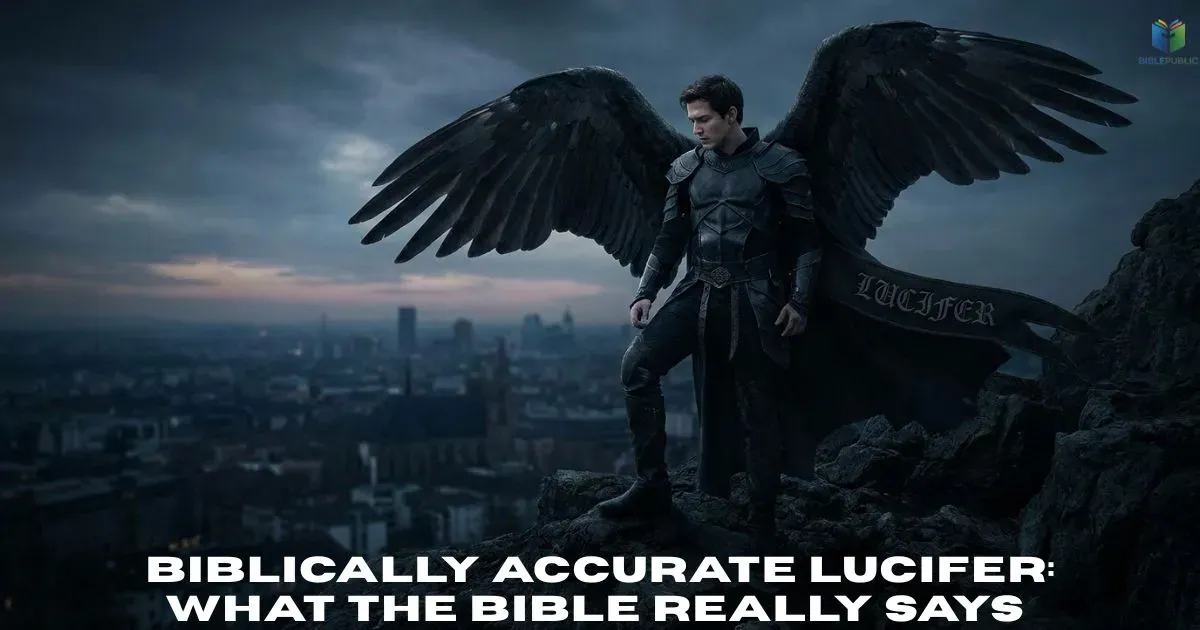
Lucifer is often shown as a beautiful angel who rebelled against God and became Satan. But what does the Bible actually say? Understanding a Biblically Accurate Lucifer means looking beyond popular images to explore Scripture, the meaning of his name, and the truth about Satan’s fall.
In this article, you’ll discover what Isaiah 14 and Ezekiel 28 reveal, why Christians interpret these passages differently, and what the Bible says about Lucifer’s appearance and origins. You’ll also learn which familiar beliefs come from Scripture and which developed through Christian tradition.
What Does Biblically Accurate Lucifer Mean?
A biblically accurate Lucifer is understood through biblical passages, their original contexts, and the Christian traditions associated with them. The phrase does not necessarily refer to a particular physical appearance or to every detail found in popular depictions of Lucifer.
The Bible does not provide one complete biography of a being explicitly named Lucifer. Instead, several passages discuss Satan, spiritual rebellion, pride, deception, and judgment. Christians have connected these passages to develop broader understandings of Satan’s identity and fall.
To understand the subject accurately, it is important to examine the meaning of the word Lucifer, its relationship to Satan, and the biblical passages traditionally associated with Satan’s origins.
Who Is Lucifer in Christian Tradition?
In traditional Christian teaching, Lucifer is commonly understood as the name of Satan before his rebellion against God. According to this interpretation, Satan was originally a glorious angel who became proud, rebelled against God, and was cast down from his former position.
This belief is particularly associated with Isaiah 14:12–15 and Ezekiel 28:12–17. Isaiah describes the downfall of a figure called the morning star in many modern translations, while Ezekiel describes the king of Tyre using imagery involving Eden, wisdom, beauty, and a guardian cherub.
Many Christians interpret these descriptions as reflecting Satan’s original glory and subsequent fall. However, neither passage explicitly presents a complete account of an angel named Lucifer rebelling against God. Isaiah introduces a taunt against Babylon’s king, while Ezekiel contains a lament concerning Tyre’s ruler.
The traditional interpretation draws connections between these passages and other biblical teachings about Satan and rebellious spiritual beings. It is therefore important to distinguish the theological conclusion from the specific details directly stated in each passage.
Is Lucifer the Same as Satan and the Devil?
In traditional Christian theology, Lucifer and Satan are generally understood to refer to the same being. The terms Satan and devil are directly associated in the New Testament, while Lucifer became associated with Satan through the translation and interpretation history of Isaiah 14:12.
Revelation 12:9 identifies the great dragon as the ancient serpent, the devil, and Satan. Within Revelation’s vision, these titles and images refer to the same adversarial figure.
The word Satan is associated with an adversary or opponent. The word devil comes from a Greek term associated with slander and accusation. Both terms describe aspects of the figure’s role in biblical narratives.
Lucifer has a different linguistic history. It comes from the Latin word traditionally used in Isaiah 14:12 to translate an expression commonly rendered in English as “morning star,” “day star,” or “shining one.” Its later use as a personal name for Satan reflects Christian interpretation rather than an explicit naming statement in the original Hebrew passage.
Therefore, Lucifer, Satan, and the devil are closely connected in Christian tradition, but their biblical and linguistic backgrounds are not identical.
What Does Lucifer Look Like According to the Bible?
The Bible does not provide a single, definitive physical description of Lucifer or Satan. Instead, it uses different images to communicate Satan’s role as a deceiver, opponent, and spiritual adversary.
These images include a serpent, a dragon, and an angel of light. Each appears in a particular literary and theological context. They should not automatically be combined into one imagined physical portrait.
A biblically accurate explanation must therefore distinguish between what Scripture depicts and what artists, writers, and popular culture have added.
Does the Bible Describe Lucifer’s Physical Appearance?
The Bible does not explicitly provide a complete physical description of Lucifer’s original appearance. It does not establish that he had horns, red skin, a pointed tail, black wings, or a particularly humanlike body.
Isaiah 14:12 uses morning-star imagery to describe the downfall of a proud ruler. Ezekiel 28:12–17 uses language about beauty, wisdom, precious stones, Eden, and a guardian cherub in a lament concerning the king of Tyre. Some Christians interpret the latter imagery as also reflecting Satan’s former glory, but this is a traditional interpretation rather than an uncontested description of Satan’s physical form.
Even if a reader accepts the traditional Satan-related interpretation, the imagery does not necessarily provide a literal portrait. References to beauty, precious stones, and an exalted position may communicate splendor and status rather than details about physical anatomy.
The most careful conclusion is that Scripture describes Satan’s actions, character, and symbolic representations more clearly than it describes his physical appearance.
The Serpent, Dragon, and Angel of Light: Understanding Biblical Imagery
Three biblical images are especially important when discussing Satan.
The serpent: Genesis 3 introduces a serpent as crafty and deceptive in the account of humanity’s temptation. Revelation 12:9 later identifies Satan as the ancient serpent, connecting Satan with the serpent imagery found earlier in Scripture. This connection is explicit in Revelation, although Genesis itself does not name Satan in its account of the serpent.
The dragon: Revelation 12 portrays a great dragon opposing the woman and her offspring. The passage identifies the dragon as the devil and Satan. The image communicates hostility, opposition, and destructive power within Revelation’s apocalyptic vision. It should not automatically be treated as a literal description of Satan’s anatomy.
The angel of light: In 2 Corinthians 11:14, Paul says that Satan disguises himself as an angel of light. The surrounding passage discusses deceptive teachers who present themselves as servants of righteousness. The point is that deception can appear trustworthy or spiritually legitimate; the verse does not establish one permanent physical form for Satan.
Together, these images communicate deception, opposition, and the danger of appearances that conceal wrongdoing. They do not establish that Satan literally possesses the physical characteristics of a serpent, dragon, and angel simultaneously.
Biblical Imagery vs. Popular Depictions of Lucifer
Popular portrayals of Lucifer often combine biblical language with artistic traditions, literature, and modern entertainment. Horns, a pointed tail, red skin, a pitchfork, and a particular winged humanoid form are familiar cultural symbols, but Scripture does not establish these as Lucifer’s definitive physical features.
Likewise, the claim that Lucifer was the most physically beautiful angel in heaven goes beyond what the Bible explicitly states. Ezekiel 28 uses language about beauty and splendor in a lament concerning Tyre’s ruler. Christians who connect the passage to Satan often understand these descriptions as reflecting Satan’s supposed former glory, but that interpretation should be identified as such.
A biblically grounded explanation should not present popular artwork as biblical fact. Scripture places greater emphasis on pride, deception, rebellion, opposition to God, and judgment than on providing a definitive visual design for Lucifer.
What Do Isaiah 14 and Ezekiel 28 Really Say?
Isaiah 14 and Ezekiel 28 are central to the traditional Christian understanding of Lucifer’s fall. Both passages describe proud rulers who experience humiliation and judgment, and both use imagery that extends beyond ordinary descriptions of political power.
Their immediate contexts are essential. Isaiah 14:4 introduces a taunt against the king of Babylon, while Ezekiel 28 contains oracles concerning the ruler and king of Tyre. The traditional connection to Satan comes from how Christians have interpreted these passages alongside other biblical teachings.
Isaiah 14:12–15 and the King of Babylon
Isaiah 14:4 introduces the passage as a taunt against the king of Babylon. The chapter describes the downfall of an oppressive ruler whose arrogance and ambition have brought him to humiliation.
In verses 12–15, the figure described as the morning star falls from heaven. He is portrayed as wanting to ascend above the stars, establish his throne, and make himself like the Most High. Instead of achieving divine status, he is brought down to the realm of the dead.
In its immediate context, this imagery communicates the downfall of a proud ruler. The language of ascending to heaven and becoming like God dramatizes his arrogance and the reversal of his apparent greatness.
Many Christians have also interpreted the passage as reflecting Satan’s rebellion and fall. This reading draws on the imagery of pride, attempted exaltation, and downfall. However, Isaiah 14 does not explicitly identify the figure in verse 12 as Satan; the passage introduces the taunt as being directed against Babylon’s king. Understanding what the Bible says about Satan’s identity and origins requires considering this passage’s original context alongside other relevant Scriptures and Christian interpretations.
What Does “Lucifer” Mean in Isaiah 14:12?
The word Lucifer comes from the Latin translation tradition of Isaiah 14:12. The underlying Hebrew expression, helel ben shachar, is commonly understood as “shining one, son of dawn” or rendered in modern English translations as “morning star, son of the dawn.”
In Latin, lucifer means “light-bearer” and was used for the morning star. In Isaiah’s passage, the image communicates the brightness and apparent height of the figure before his downfall. Later Christian interpreters connected this passage with Satan’s rebellion, and Lucifer consequently became a familiar name for Satan in Christian tradition.
This history explains why some translations use “Lucifer,” while many modern translations use “morning star,” “day star,” or “shining one.” For example, Isaiah 14:12 in the NABRE translation uses the wording “Morning Star.” The translation choice should not be confused with an explicit statement that Satan was originally given the personal name Lucifer.
The distinction is important because morning-star language appears elsewhere in Scripture. Revelation 22:16, for example, identifies Jesus as the bright Morning Star. The expression itself does not uniquely identify Satan; its meaning depends on its context.
Ezekiel 28:12–17 and the King of Tyre
Ezekiel 28 contains a lament concerning the king of Tyre. The surrounding verses describe a ruler whose wisdom, wealth, and success contributed to his pride. The passage uses striking imagery involving Eden, precious stones, a holy mountain, and a guardian cherub before describing the figure’s corruption and downfall.
Many Christians interpret this passage as referring not only to the earthly king but also, symbolically or typologically, to Satan. In this reading, the descriptions of beauty, an exalted position, and corruption through pride are understood as reflecting Satan’s former glory and rebellion.
Other interpreters emphasize the passage’s direct focus on Tyre’s ruler. Its references to wealth, trading, violence, and political pride fit the chapter’s condemnation of Tyre’s power and corruption. Some scholarly interpretations understand the Eden and cherub imagery as poetic or symbolic language describing the king’s privileged status and eventual humiliation.
The passage therefore provides important material for understanding the traditional Christian account of Satan’s fall, but it does not explicitly name Satan or Lucifer. Its original context must remain central to any explanation.
Why Christians Interpret These Passages Differently
Christians interpret Isaiah 14 and Ezekiel 28 differently because the passages use vivid imagery while addressing identifiable earthly rulers in their immediate contexts.
Three broad approaches help explain these differences:
- Historical or contextual interpretation: The passages primarily condemn the kings of Babylon and Tyre, using elevated or symbolic language to portray their arrogance and downfall.
- Traditional Satan-related interpretation: The language of heavenly status, pride, and expulsion is understood as also revealing something about Satan’s rebellion and fall.
- Layered or typological interpretation: The earthly ruler is the immediate subject, while the imagery is also understood to reflect a broader spiritual pattern associated with Satan.
These approaches do not always divide neatly into separate groups. Some Christian interpreters affirm the historical context while also seeing a broader spiritual significance in the imagery.
The responsible approach is to explain the direct context first, then describe the traditional interpretation and its reasoning. This allows readers to understand why the passages matter without claiming that every detail is explicitly stated in the text.
Was Lucifer an Angel Before He Fell?
The belief that Lucifer was once a good angel who rebelled against God is a longstanding Christian teaching. It draws on biblical passages about Satan, sinful spiritual beings, pride, and divine judgment.
However, Scripture does not present a single, complete account that names Lucifer as an angel, describes every stage of his rebellion, and provides an exact timeline. Much of the traditional narrative comes from reading multiple passages together. Isaiah 14 and Ezekiel 28 are central to this interpretation, but their immediate subjects are the kings of Babylon and Tyre.
Was Satan Originally a Good Angel?
Many Christians believe Satan was originally a good angel who rebelled against God. This view is commonly supported by interpretations of Ezekiel 28 and by passages referring to angels who sinned or abandoned their proper position.
Second Peter 2:4 refers to angels who sinned and were judged, while Jude 6 speaks of angels who did not keep their proper position. These passages support the belief that some spiritual beings rebelled against God, but neither explicitly names Lucifer or provides a complete account of Satan’s original state.
The traditional conclusion is that Satan was created good but became corrupt through rebellion. That conclusion represents a Christian synthesis of relevant biblical passages rather than a complete story told in one place.
It is therefore more accurate to describe Satan’s original goodness as a traditional Christian understanding based on broader biblical interpretation, rather than claiming that Scripture explicitly narrates every detail of his origins.
Was Lucifer a Cherub According to Ezekiel 28?
Ezekiel 28:14 describes the figure in its lament as a guardian cherub in many English translations. This language is one reason the passage has played such an important role in traditional accounts of Lucifer’s origins.
A cherub is a heavenly being associated in several biblical passages with God’s presence and sacred space. Cherubim appear in Genesis 3:24 and in descriptions of God’s presence elsewhere in Scripture.
In the traditional Satan-related interpretation of Ezekiel 28, the guardian cherub represents Satan’s former exalted position before his fall. Yet the passage itself addresses the king of Tyre, and its imagery is not universally understood as a literal description of Satan. Some interpreters understand the cherub language as part of a poetic portrayal of the king’s privileged status and subsequent humiliation.
The most accurate conclusion is that Ezekiel 28 provides a basis for the traditional belief that Satan was a cherub, but the text does not explicitly state that Satan was a cherub.
Did Satan Fall Because of Pride?
Pride is central to the traditional Christian explanation of Satan’s fall. Isaiah 14 describes a ruler who seeks to exalt himself above the stars and become like the Most High. Ezekiel 28 describes the king of Tyre becoming proud because of his beauty and corrupting his wisdom because of his splendor. Both passages connect arrogance with downfall.
When these passages are applied to Satan, pride is understood as the central motive behind his rebellion. This interpretation also fits the broader biblical warning against arrogance and self-exaltation.
However, the direct context must remain clear. Isaiah addresses Babylon’s king, and Ezekiel addresses Tyre’s ruler. Neither passage provides a direct, standalone statement that Satan fell because of pride.
The theological connection is meaningful within Christian tradition, but it should be presented as an interpretation drawn from these texts rather than as an uncontested historical account.
Does the Bible Reveal When Satan Fell?
The Bible does not provide a universally agreed chronological timeline for Satan’s fall. Several passages are relevant, but Christians interpret them in different ways.
In Luke 10:18, Jesus says that he saw Satan fall like lightning from heaven. Some Christians understand this as referring to Satan’s original rebellion; others interpret it in connection with the disciples’ mission and the defeat of Satan’s influence through Jesus’ ministry.
Revelation 12:7–9 describes a battle in heaven in which Michael and his angels fight the dragon, identified as the devil and Satan. The dragon is cast down to earth along with his angels. Christians differ over how this vision relates chronologically to Satan’s original rebellion, Jesus’ victory, and events associated with the end times.
These passages portray Satan’s defeat and loss of position in their respective contexts, but they do not provide a universally agreed timeline for every stage of his fall. It is more accurate to acknowledge the interpretive differences than to assign a precise date or sequence that Scripture does not clearly establish.
What Does the Bible Say About Fallen Angels and Demons?
The Bible describes Satan as a spiritual adversary and refers to angels associated with him. It also describes demons as spiritual beings who oppose God’s purposes and harm people. However, Scripture does not provide a complete systematic account of the origin, hierarchy, or nature of every demonic being.
Christian traditions commonly connect demons with fallen angels, but the relevant biblical passages should be examined individually rather than treated as if they all state the same thing. Revelation 12:9 mentions Satan and his angels, while the Gospels describe Jesus confronting demons. These accounts contribute to Christian understandings of spiritual evil, but they do not answer every question about its origins.
What Scripture Says About Satan’s Angels
Revelation 12:7–9 describes the dragon fighting against Michael and his angels. The dragon is identified as the devil and Satan, and the passage states that his angels are cast down with him. Matthew 25:41 also refers to the devil and his angels in the context of final judgment.
These passages provide a biblical basis for speaking about spiritual beings associated with Satan. They also contribute to the traditional Christian belief that Satan leads other rebellious spiritual beings.
The relationship between these angels and demons is commonly understood in Christian theology as a connection between fallen angels and demonic spirits. Nevertheless, the Bible does not explicitly explain every detail of that relationship or offer a complete classification of all spiritual beings. It is therefore important not to invent a detailed hierarchy or origin story beyond what the text supports.
What the Bible Says About the Limits of Demonic Power
The Bible portrays Satan and demonic powers as dangerous but not equal to God. Satan is depicted as a deceiver and adversary, yet he does not possess unlimited authority or power equal to the Creator.
Job 1–2 illustrates this distinction in the narrative of Job. Satan challenges Job’s integrity, but his actions occur within limits set by God. The passage does not answer every theological question about suffering or spiritual warfare, but it portrays Satan’s power as constrained rather than absolute.
The New Testament also calls believers to resist the devil. James 4:7 instructs believers to submit to God and resist the devil, while 1 Peter 5:8–9 warns Christians to remain alert and stand firm in faith. These passages emphasize vigilance and dependence on God rather than fear of demonic power.
Christians differ in how they explain the details of spiritual warfare, but the biblical emphasis is clear: evil is real within the biblical worldview, yet it does not possess authority equal to God or escape the limits of divine sovereignty.
Does Satan Rule Hell or Have Power Equal to God?

A common popular image portrays Satan as the ruler of hell, commanding demons and punishing the wicked. The Bible does not establish this as his role. Instead, Scripture portrays Satan as an adversary who deceives, opposes God’s purposes, and ultimately faces divine judgment.
Revelation 20:10 describes the devil being thrown into the lake of fire, where he faces judgment. In this passage, Satan is not depicted as the sovereign ruler of a kingdom where he freely governs the punishment of others. He is among those receiving judgment under God’s authority.
It is also important to distinguish biblical terms associated with the afterlife. Sheol, Hades, Gehenna, and the lake of fire do not always refer to precisely the same concept in every passage or translation. Their meanings depend on their scriptural contexts. Consequently, descriptions of Satan ruling hell should not be treated as direct biblical teaching.
Satan is also not equal to God. Christian theology understands God as the Creator and Satan as a created spiritual being. Biblical passages portray Satan as powerful enough to tempt and deceive, but never as an independent power equal to God in authority or sovereignty.
Job 1–2 shows Satan acting within limits, and Revelation 20:10 depicts his ultimate judgment. Together, these passages support the conclusion that Satan’s power is limited and that his final destiny is determined by God.
For Christians, this distinction is significant: the biblical narrative does not present a struggle between two equally powerful beings whose ultimate victory is uncertain. It presents evil as real but ultimately subject to God’s authority.
How Can Christians Resist Satan According to Scripture?

The Bible’s response to Satan is not to encourage fascination with his appearance or supposed powers, but to call believers to faithfulness, discernment, and dependence on God.
James 4:7 instructs believers to submit to God and resist the devil. The order matters: resistance is connected to submission to God, not confidence in human power alone. The passage encourages a life oriented toward God rather than one dominated by fear of Satan.
First Peter 5:8–9 warns Christians to remain alert because the devil is portrayed as an adversary seeking someone to devour. The passage urges believers to resist him and remain firm in their faith. This is a call to spiritual vigilance and perseverance, not an instruction to attribute every hardship or temptation to direct demonic activity.
Ephesians 6:10–18 describes the armor of God, including truth, righteousness, faith, salvation, God’s word, and prayer. The passage presents spiritual struggle through the imagery of a soldier equipped to stand firm. Its emphasis is on spiritual integrity, faithfulness, and reliance on God.
These teachings provide practical guidance for Christians:
- Remain grounded in Scripture: Evaluate spiritual claims and teachings carefully rather than accepting them because they appear impressive or supernatural.
- Practice humility: Avoid the pride and self-exaltation associated with rebellion against God in the traditional interpretation of Lucifer’s fall.
- Resist temptation: Seek to follow God’s commands and reject deception, wrongdoing, and destructive choices.
- Remain firm in faith: Respond to spiritual challenges with trust in God, prayer, and perseverance.
- Avoid unnecessary fear and speculation: Focus on what Scripture teaches instead of inventing details about Satan’s appearance, abilities, or influence.
The Bible presents resistance to Satan as part of a broader commitment to God. Its emphasis is not on mastering secret knowledge about the devil, but on living faithfully, discerning truth from deception, and trusting God’s authority.
Conclusion
Understanding a Biblically Accurate Lucifer means separating what Scripture clearly says from later Christian beliefs and popular images. Isaiah 14 and Ezekiel 28 address earthly rulers, though many Christians also connect their imagery to Satan’s fall. The Bible focuses more on pride, deception, and judgment than on Lucifer’s physical appearance or exact origins.
To understand this topic more deeply, read the relevant Bible passages in context and compare their wording across trusted translations. Consider how Christian traditions interpret these passages, but avoid treating every traditional belief as a direct biblical statement. This approach will help you build a clearer understanding of Lucifer and what Scripture teaches about Satan.
Frequently Asked Questions
Does the Bible explicitly call Satan Lucifer?
No, the original Hebrew text of Isaiah 14:12 does not explicitly name Satan as Lucifer. The name comes from the Latin translation tradition and later Christian interpretations of the passage.
What does a Biblically Accurate Lucifer look like?
The Bible does not provide a complete physical description of Lucifer. Images such as the serpent, dragon, and angel of light communicate different aspects of Satan’s role rather than establishing one literal appearance.
Was Lucifer really an angel before he rebelled against God?
Many Christians believe Satan was originally a good angel who rebelled against God. However, Scripture does not provide a complete account of Lucifer’s origins, and this belief draws on interpretations of several passages.
Why do Christians connect Lucifer with Isaiah 14 and Ezekiel 28?
Christians connect these passages with Satan’s fall because they describe pride, exaltation, and downfall. However, Isaiah addresses Babylon’s king, while Ezekiel’s passage concerns Tyre’s ruler in its immediate context.
Does the Bible say Lucifer had horns or black wings?
No, the Bible does not establish horns, black wings, red skin, or a pointed tail as Lucifer’s physical features. These details come from artistic traditions and popular culture rather than a definitive biblical description.
How can Christians understand Lucifer’s story without becoming afraid?
Christians can study relevant passages in context and focus on God’s guidance rather than frightening images. James 4:7 encourages believers to submit to God and resist the devil, emphasizing faithfulness and trust in God.

Chris Saadil is the founder of BiblePublic.com, where he shares biblical insights to help readers understand God’s Word and grow in faith. His mission is to make Scripture clear, practical, and encouraging through Bible verses, biblical teachings, prayer, and Christian living, helping believers build a deeper relationship with God every day.






1 thought on “Biblically Accurate Lucifer: What the Bible Really Says”