
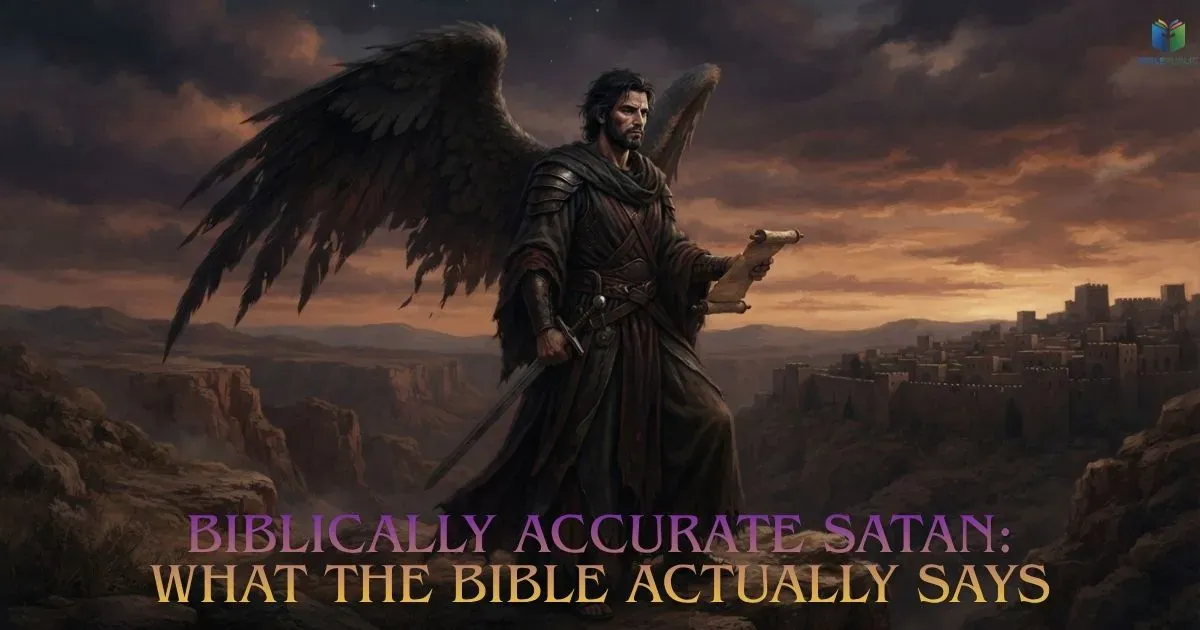
Understanding a Biblically Accurate Satan means looking beyond popular images to discover what Scripture actually teaches. The Bible describes Satan as an adversary who tempts, deceives, and opposes God’s purposes. It also reveals important truths about his identity, actions, and ultimate fate.
In this article, you will explore biblical descriptions of Satan, the meaning of his names, and what Scripture says about his fall and power. You will also learn how to distinguish direct biblical teachings from traditional Christian beliefs and understand how Christians can resist temptation through faith and God’s Word.
What Does “Biblically Accurate Satan” Mean?

A biblically accurate understanding of Satan focuses on what Scripture reveals about his identity, character, actions, and ultimate fate rather than relying on popular images. The Bible describes him as an adversary of God who works through temptation, deception, and accusation.
The name Satan is associated with the Hebrew word for an adversary, while devil comes from a Greek word meaning slanderer or false accuser. These terms emphasize his opposition to God’s purposes.
Revelation 12:9 identifies the dragon as “that old serpent, called the Devil, and Satan, which deceiveth the whole world” (KJV). This passage connects several biblical descriptions to the same adversarial figure, but it does not provide a complete physical portrait.
Understanding Satan accurately therefore requires distinguishing direct biblical statements from symbolic imagery, traditional Christian beliefs, and details that Scripture does not establish.
Who Is Satan According to the Bible?
The Bible portrays Satan as a spiritual adversary who opposes God and seeks to lead people away from truth and obedience.
In Job 1-2, Satan challenges Job’s integrity, suggesting that Job serves God because of the blessings he receives. God permits Job to be tested within limits, demonstrating that Satan does not act independently of divine authority.
In Genesis 3, the serpent questions God’s command and persuades Eve to eat the forbidden fruit. Genesis describes the creature as a serpent; Revelation 12:9 and 20:2 later identify the ancient serpent with the devil and Satan.
The New Testament also describes Satan as a tempter (Matthew 4:1-11), associates the devil with falsehood (John 8:44), and warns believers to remain alert to their adversary (1 Peter 5:8). These passages emphasize Satan’s methods rather than his physical appearance.
How Does the Biblical Description of Satan Differ From Popular Depictions?
Popular culture often portrays Satan as a horned creature with red skin, cloven hooves, and a pitchfork. Scripture does not provide this combined description.
Instead, the Bible emphasizes his actions and uses symbolic imagery. Matthew 4:1-11 describes Satan tempting Jesus in the wilderness. Revelation 12 portrays him as a dragon, while 2 Corinthians 11:14 warns that “Satan himself is transformed into an angel of light” (KJV).
Paul uses the angel-of-light image while warning about false apostles who disguise themselves as servants of righteousness (2 Corinthians 11:13-15). The point is that deception can appear attractive or trustworthy rather than obviously evil.
The biblical picture is therefore less concerned with a recognizable outward appearance and more concerned with Satan’s character, influence, and opposition to God.
What Does Satan Look Like According to the Bible?
The Bible does not provide a complete physical description of Satan. Instead, it uses different images in different literary settings to communicate aspects of his identity and activity.
These images should be interpreted in context rather than combined into a single literal portrait.
Does the Bible Describe Satan’s Physical Appearance?
No biblical passage gives a comprehensive description of Satan’s height, skin color, facial features, clothing, or permanent bodily form.
Genesis 3 describes the serpent who tempts Eve. Revelation 12:3-9 depicts a great red dragon with multiple heads and horns and identifies the dragon as Satan in verse 9. Because Revelation uses apocalyptic imagery, its description should not automatically be treated as a literal anatomical portrait.
Second Corinthians 11:14 compares Satan’s deceptive appearance to “an angel of light” (KJV). In context, Paul is warning believers about false teachers who appear righteous while leading people astray.
These passages reveal important aspects of Satan’s biblical portrayal, but they do not establish a single physical appearance. The familiar horned devil with a tail and pitchfork is a cultural and artistic representation, not a complete description supplied by Scripture.
What Do the Serpent, Dragon, and Angel of Light Represent?
Three important biblical images help explain Satan’s character and methods.
- The serpent: In Genesis 3:1-5, the serpent questions God’s command and encourages Eve to distrust God’s words. Revelation 12:9 later identifies Satan as “that old serpent” (KJV), connecting him with the deception associated with Eden.
- The dragon: Revelation 12 depicts a great dragon opposing the woman and her child. Verse 9 identifies the dragon as the devil and Satan. The vision uses apocalyptic imagery to portray spiritual conflict and opposition to God’s purposes.
- The angel of light: In 2 Corinthians 11:14, Paul warns that Satan can appear as “an angel of light” (KJV). The comparison emphasizes that deception may imitate goodness, righteousness, or spiritual authority.
These images communicate different aspects of Satan’s activity. They should not be treated as proof that he possesses the literal physical features of a serpent, dragon, and angel simultaneously.
Which Features Commonly Associated With Satan Are Not Explicitly Described in Scripture?
Several familiar features associated with Satan are not directly established by the Bible:
- Red skin: Revelation describes a red dragon, but it does not say Satan ordinarily appears as a red-skinned humanoid.
- Horns and a pointed tail: Revelation 12 includes a dragon with horns, but its symbolic imagery does not establish the familiar horned devil of popular art as Satan’s literal form.
- Cloven hooves and a pitchfork: Scripture does not describe Satan with these features.
- A permanent humanoid body: The Bible does not provide a comprehensive account of Satan’s physical form.
- A throne in hell: Scripture portrays Satan as facing judgment, not as the sovereign ruler of hell.
Artistic representations can communicate theological ideas, but they should not be confused with explicit biblical teaching. Scripture gives considerably more information about Satan’s deception, temptation, opposition, and judgment than about his physical appearance.
Who Was Satan Before His Fall?

Many Christian traditions teach that Satan was originally a good angel who rebelled against God. This understanding draws on biblical passages about sinful angels, the downfall of proud rulers, and Satan’s defeat in Revelation. Although Scripture does not provide a single chronological account of Satan’s creation, original position, rebellion, and expulsion from heaven, several passages are traditionally interpreted together to explain his fall. Understanding what the Bible says about Satan’s fall and origins requires distinguishing explicit biblical statements from traditional Christian interpretations.
Was Satan Originally a Good Angel?
Many Christians believe Satan was created good and later rebelled against God. This view understands evil spiritual beings as having turned away from their proper relationship with God rather than having been created evil by nature.
Jude 6 refers to angels who “kept not their first estate, but left their own habitation” (KJV). Second Peter 2:4 also speaks of angels who sinned. These passages establish that Scripture describes sinful angels, but neither explicitly identifies Satan as their leader in its immediate wording.
Ezekiel 28:12-17 is also frequently cited because it describes a figure associated with Eden, beauty, wisdom, and corruption. However, Ezekiel 28:11 identifies the subject of the lament as the king of Tyre. Some Christians see a deeper reference to Satan behind the imagery, while others understand it primarily as a poetic description of the ruler’s pride and downfall.
The belief that Satan was originally a good angel is a longstanding Christian interpretation based on several passages. Scripture clearly portrays Satan as God’s adversary, but it does not provide an undisputed, detailed biography of his original state.
How Are Isaiah 14 and Ezekiel 28 Connected to Satan’s Origins?
Isaiah 14:4 introduces a taunt against the king of Babylon. Isaiah 14:12-15 describes the downfall of the figure called “Lucifer” in the King James Version. Ezekiel 28:11–19 contains a lament concerning the king of Tyre, using imagery of exceptional beauty, Eden, and eventual corruption.
Both passages have traditionally been connected to Satan’s fall because they describe pride, self-exaltation, and downfall. Their immediate contexts, however, concern human rulers.
In Isaiah 14:13-14, the ruler declares his ambition to ascend above his proper position and become like the Most High. In context, this language mocks the arrogance of Babylon’s king. The Hebrew expression rendered “Lucifer” in the KJV is associated with a shining one or morning star.
Ezekiel 28:17 states, “Thine heart was lifted up because of thy beauty, thou hast corrupted thy wisdom by reason of thy brightness” (KJV). The verse directly belongs to the lament concerning the king of Tyre. Some Christians interpret its imagery as also reflecting Satan’s pride and rebellion; others understand it as poetic language describing the king’s downfall.
Neither passage explicitly names Satan as its immediate human subject. Connecting these texts to Satan’s origins is a traditional theological interpretation, not an uncontested statement of the passages themselves.
Why Did Satan Fall From Heaven?
Christian tradition commonly explains Satan’s fall as the result of pride and rebellion against God. This interpretation draws on Isaiah 14, Ezekiel 28, Luke 10:18, and Revelation 12:7-9.
These passages do not provide one continuous chronology of Satan’s fall. Christians differ over whether they describe an original rebellion before human history, Satan’s defeat through Christ’s ministry and victory, or different aspects of spiritual conflict.
Does the Bible Say Satan Fell Because of Pride?
Pride is the traditional explanation for Satan’s rebellion in much of Christian theology, but Scripture does not provide a single, explicit narrative identifying the cause and chronology of Satan’s first sin.
Isaiah 14:13-14 describes a ruler seeking to exalt himself above his proper position. Ezekiel 28:17 says that the heart of the ruler was lifted up because of his beauty. Both passages directly address human kings, but many Christians interpret their descriptions of arrogance and downfall as reflecting Satan’s rebellion.
First Timothy 3:6 warns against appointing a recent convert as a bishop, “lest being lifted up with pride he fall into the condemnation of the devil” (KJV). This connects pride with the devil’s condemnation but does not provide a detailed account of Satan’s original history.
Together, these passages support the biblical warning that pride and self-exaltation lead to downfall. The traditional explanation that Satan’s rebellion began with pride should be understood as a theological conclusion drawn from several texts rather than a complete account explicitly narrated in Scripture.
What Does Jesus Mean When He Says He Saw Satan Fall Like Lightning?
In Luke 10:17-20, Jesus’ disciples return from their mission rejoicing because devils are subject to them through his name. Jesus responds in Luke 10:18, “I beheld Satan as lightning fell from heaven” (KJV).
Some Christians understand this statement as referring to Satan’s original fall from heaven. Others interpret it in the immediate context of the disciples’ ministry, viewing Satan’s fall as a picture of his defeat as God’s kingdom advances.
The surrounding verses support the importance of the disciples’ mission. Jesus speaks about the authority given to his followers in Luke 10:19 and then redirects their joy toward the fact that their names are written in heaven (Luke 10:20).
Luke 10:18 clearly speaks of Satan falling, but the verse alone does not settle when that fall occurred or how it relates chronologically to Revelation 12.
What Does Revelation 12:7-9 Reveal About Satan’s Fall?
Revelation 12:7-9 describes war in heaven. Michael and his angels fight against the dragon and his angels. The dragon is defeated and cast down to the earth. Revelation 12:7–9 in the King James Version identifies the dragon in verse 9 as “that old serpent, called the Devil, and Satan, which deceived the whole world” (KJV).
Unlike Isaiah 14 and Ezekiel 28, Revelation explicitly names Satan. The passage depicts his defeat and the expulsion of the spiritual forces aligned with him.
The larger chapter uses apocalyptic imagery, including a woman, a male child, a dragon, and heavenly warfare. Some Christians interpret the conflict as Satan’s original rebellion; others connect it with Christ’s victory and Satan’s loss of his accusatory position. Interpretations differ over the vision’s chronology and its relationship to events in salvation history.
The central message remains that Satan does not prevail. Revelation presents his defeat as part of God’s victory over evil, even though Christians differ about the precise timing and interpretation of the vision.
What Is the Difference Between Satan, the Devil, Lucifer, and Demons?
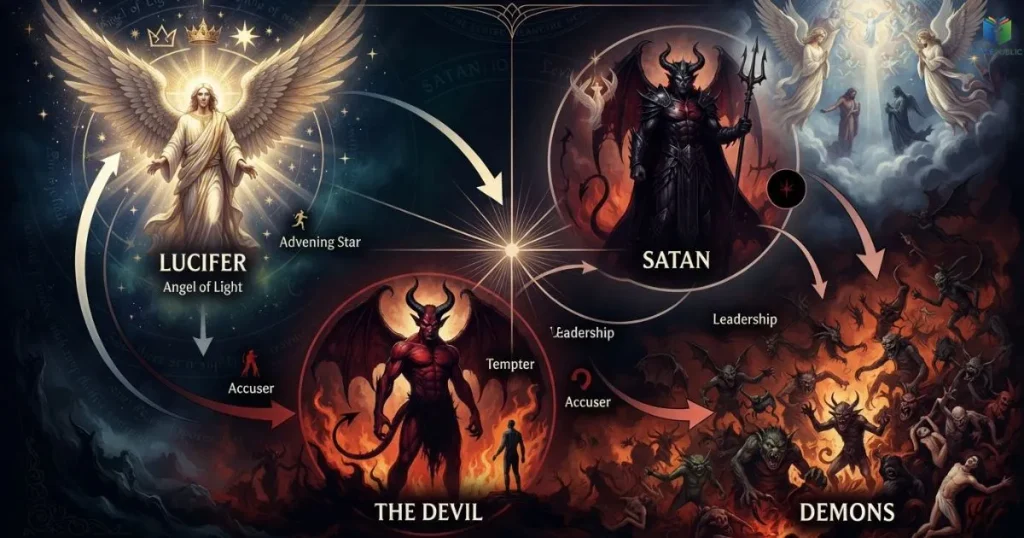
These terms are related but do not function identically in Scripture. Satan and the devil refer to the same adversary in the New Testament, while Lucifer is traditionally used as a name for Satan in Christian theology. Demons are evil spiritual beings associated with spiritual opposition, but what the Bible says about demons and their origins requires careful interpretation because Scripture does not explain their relationship to fallen angels in one systematic account.
Are Satan and the Devil the Same Being?
Yes. Revelation 12:9 identifies the dragon as “the Devil, and Satan,” and Revelation 20:2 repeats this identification (KJV). Both terms refer to the same adversary.
Satan is associated with the Hebrew term for an adversary or opponent. Devil comes from a Greek term meaning slanderer or false accuser. The terms emphasize his opposition to God and his role in deception and accusation.
Other passages describe specific aspects of his activity. Matthew 4:3 presents Satan as the tempter, while Revelation 12:10 calls him the accuser. These descriptions are not references to separate beings but emphasize different aspects of the same adversary.
Is Lucifer Another Name for Satan in Christian Tradition?
In traditional Christian usage, Lucifer is commonly treated as a name for Satan in connection with his fall. The association comes especially from Isaiah 14:12 in the KJV: “How art thou fallen from heaven, O Lucifer, son of the morning!” (KJV).
The immediate context is a taunt against the king of Babylon (Isaiah 14:4). The Hebrew expression translated as “Lucifer” is associated with a shining one or morning star, and the passage describes the downfall of an exalted ruler.
Many Christian interpreters later connected this language of heavenly downfall and self-exaltation with Satan’s rebellion, especially when reading Isaiah 14 alongside Ezekiel 28 and New Testament passages about the devil.
Therefore, Lucifer is a traditional Christian name for Satan, but readers should recognize that Isaiah 14 does not explicitly identify its immediate subject as Satan.
Are Demons the Same as Fallen Angels?
Many Christian traditions identify demons as evil spirits associated with Satan and understand them as fallen angels. However, Scripture does not explicitly state in one systematic account that every demon is a fallen angel.
Second Peter 2:4 speaks of angels who sinned, and Jude 6 describes angels who abandoned their proper position. The Gospels also describe Jesus casting out demons, including in Mark 1:34 and Luke 8:26-33.
Revelation 12:9 refers to the dragon’s angels being cast down with him. Many Christians connect these beings with the broader biblical teaching about demonic opposition, but Scripture does not explain every detail of the relationship between demons and fallen angels.
The traditional connection is widespread, yet it is important to distinguish that interpretation from what the individual passages explicitly state.
What Does the Bible Say About Satan’s Angels?
Revelation 12:7-9 describes the dragon fighting against Michael and his angels. After the dragon is defeated, his angels are cast down with him. Matthew 25:41 also refers to “the devil and his angels” (KJV) in the context of judgment.
These passages portray spiritual beings aligned with Satan in opposition to God. They do not provide a complete account of their number, hierarchy, or original history.
Christians commonly describe Satan’s angels as fallen angels, connecting these passages with Jude 6 and 2 Peter 2:4. Although the interpretation is widely held, Scripture does not explain every detail of their fall or organization.
The central teaching is that Satan does not act alone in the biblical portrayal of spiritual evil, but neither he nor his angels are beyond God’s authority or final judgment.
What Does the Bible Say About Satan’s Powers and Limitations?
The Bible portrays Satan as dangerous but not all-powerful. He can tempt, deceive, accuse, and oppose God’s people, yet he is not equal to God and cannot escape the judgment Scripture describes.
Can Satan Tempt, Deceive, and Accuse People?
Yes. Matthew 4:1-11 describes Satan tempting Jesus in the wilderness and attempting to persuade him to disobey God. Jesus responds with Scripture and refuses to yield.
Genesis 3 shows the serpent questioning God’s command, while Revelation 12:9 describes Satan as the one who deceives the world. Revelation 12:10 also calls him “the accuser of our brethren” (KJV), and Job 1-2 portrays him challenging Job’s integrity.
These passages establish deception, temptation, and accusation as recurring features of Satan’s biblical portrayal. However, the Bible does not teach that every struggle or sinful thought comes directly from Satan. James 1:14 also explains that people can be drawn away by their own desires. A balanced understanding considers both spiritual opposition and human responsibility.
Is Satan as Powerful as God?
No. Scripture does not present Satan as God’s equal. God is sovereign, while Satan’s activity remains subject to divine authority.
In Job 1-2, Satan can test Job only within limits established by God. In Matthew 4:1-11, Satan attempts to tempt Jesus but cannot overcome his obedience. Revelation 20:1-10 ultimately depicts Satan being bound, released, and then cast into the lake of fire.
Christians interpret some details of these events differently, but the broader message is consistent: Satan’s power is limited, and he cannot overthrow God’s ultimate purposes.
Does Satan Rule Hell According to the Bible?
No. The familiar image of Satan ruling hell from a throne is not established by Scripture. The Bible portrays him as facing judgment rather than governing a kingdom equal to God’s.
Matthew 25:41 refers to “everlasting fire, prepared for the devil and his angels” (KJV). Revelation 20:10 states that the devil will be cast into the lake of fire and brimstone.
The Bible uses different terms and images when discussing final punishment, and their relationship varies by passage and theological interpretation. However, it does not depict Satan as the sovereign ruler of God’s place of punishment. He is among those who face judgment.
What Does the Bible Say About Satan’s Final Fate?
The Bible presents Satan’s ultimate defeat as part of God’s final victory over evil. His opposition does not continue indefinitely, and he does not ultimately prevail against God’s purposes.
What Does Revelation Say About Satan’s Final Judgment?
Revelation 20:7-10 describes Satan being released after a period of confinement. He deceives the nations and gathers them for a final rebellion against God’s people. The rebellion is defeated, and Satan is cast into the lake of fire and brimstone.
Revelation 20:10 states that the devil will be tormented day and night for ever and ever (KJV). The passage presents his final judgment as decisive.
Christians differ over the chronology and symbolism of Revelation, including how the millennium should be understood. Nevertheless, the passage’s central message is that Satan’s rebellion ends in judgment. He does not take control of God’s kingdom or escape divine justice.
How Can Christians Resist Satan According to the Bible?

The Bible’s teaching about Satan also offers practical guidance for Christian living. Believers are instructed to resist temptation, remain alert to deception, submit to God, and stand firm in their faith. The emphasis is not on becoming fascinated with Satan’s appearance but on living faithfully before God.
What Does James 4:7 Teach About Resisting the Devil?
James 4:7 states, “Submit yourselves therefore to God. Resist the devil, and he will flee from you” (KJV).
The order is important: believers are first instructed to submit to God and then to resist the devil. The surrounding verses call for humility, repentance, and sincere devotion. James 4:6 teaches that God gives grace to the humble, while James 4:8 urges readers to draw near to God and purify their hearts.
In practice, resisting the devil includes rejecting temptation, refusing deception, seeking God’s wisdom, confessing sin, and choosing obedience. James does not promise a life without hardship or temptation; he calls believers to resist evil through humble submission to God.
How Does the Armor of God Help Christians Stand Firm?
Ephesians 6:10-18 describes the armor of God as a picture of the spiritual resources believers need to withstand evil. Paul instructs Christians to put on “the whole armour of God” so they can stand against the devil’s schemes (Ephesians 6:11, KJV).
The passage identifies several elements:
- The belt of truth: Truth helps believers recognize and reject deception (Ephesians 6:14).
- The breastplate of righteousness: Righteous living reflects obedience to God (Ephesians 6:14).
- The preparation of the gospel of peace: The gospel gives believers a firm foundation and readiness to stand (Ephesians 6:15).
- The shield of faith: Trust in God helps believers withstand the “fiery darts of the wicked” (Ephesians 6:16, KJV).
- The helmet of salvation: Salvation provides confidence in God’s saving work (Ephesians 6:17).
- The sword of the Spirit: Paul identifies this as “the word of God” (Ephesians 6:17, KJV).
- Prayer: Ephesians 6:18 calls believers to pray with perseverance and supplication.
Paul begins by urging Christians to be strong “in the Lord, and in the power of his might” (Ephesians 6:10, KJV). The armor is not a collection of magical objects or a guarantee that believers will avoid every hardship. It represents reliance on God through truth, righteousness, faith, salvation, Scripture, and prayer.
Ephesians 6:12 also reminds believers that their struggle is not against flesh and blood. This encourages Christians to resist evil without treating other people as the ultimate enemy.
Conclusion
Understanding a Biblically Accurate Satan means looking beyond popular images and focusing on what Scripture actually teaches. The Bible describes Satan as a spiritual adversary who tempts, deceives, and accuses people. It also shows that his power is limited and his final defeat is certain. Knowing the difference between biblical truth and tradition helps readers understand this subject more clearly.
As you study Scripture, read each passage in its original context and separate clear biblical statements from traditional interpretations. Reflect on James 4:7, which teaches believers to submit to God and resist the devil. Stay grounded in God’s Word, pray for wisdom, and focus on living faithfully rather than becoming distracted by fear or speculation.
Explore More Biblical Insights About Satan
Understanding Satan through Scripture means examining his identity, actions, and place in biblical teaching. Exploring additional biblical resources can help you better understand spiritual opposition, the meaning of scriptural imagery, and the differences between explicit biblical teachings and traditional Christian interpretations. These insights can deepen your understanding of Satan while keeping Scripture at the center of your study.
Fallen Angels in the Bible: What Scripture Reveals About Their Rebellion
Biblically Accurate Lucifer: What the Bible Really Says
Frequently Asked Questions
What does the Bible actually teach about Satan’s identity and role?
The Bible presents Satan as an adversary, tempter, and deceiver. A biblically accurate view of Satan follows Scripture’s descriptions rather than popular images or unsupported beliefs.
What does the Bible say about Satan’s physical appearance?
The Bible does not provide a complete physical description of Satan. Popular images of a red figure with horns and a pitchfork come from cultural traditions, not direct biblical descriptions.
Was Satan originally an angel, according to the Bible?
The Bible does not provide one complete account of Satan’s origin. Some Christians connect Isaiah 14 and Ezekiel 28 with his fall, although both passages address earthly rulers in context.
Does Isaiah 14:12 identify Lucifer as Satan in the Bible?
Isaiah 14:12 uses the name Lucifer in the King James Version. The passage addresses Babylon’s king, while identifying Lucifer with Satan reflects a traditional Christian interpretation.
Does the Bible teach that Satan is equal to God in power?
No, Scripture does not present Satan as God’s equal. Revelation 20:10 describes Satan’s final judgment, showing that evil will not ultimately overcome God’s authority.
How can Christians recognize Satan’s deception according to Scripture?
Christians can guard against deception by studying Scripture and testing teachings carefully. In 2 Corinthians 11:14, Paul warns that Satan can transform himself into an angel of light.

Chris Saadil is the founder of BiblePublic.com, where he shares biblical insights to help readers understand God’s Word and grow in faith. His mission is to make Scripture clear, practical, and encouraging through Bible verses, biblical teachings, prayer, and Christian living, helping believers build a deeper relationship with God every day.






3 thoughts on “Biblically Accurate Satan: What the Bible Actually Says”