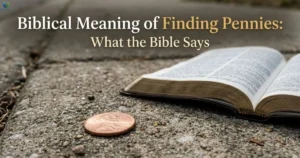
Finding a penny on the ground may seem like a small event, but it can raise questions about faith and God’s guidance. The Biblical Meaning of Finding Pennies is not directly explained in Scripture, and the Bible does not identify finding a penny as a special sign from God.
In this article, you’ll explore what the Bible says about ancient coins, spiritual signs, and everyday blessings. You’ll also learn how biblical teachings on gratitude, faithfulness, and generosity can help you reflect on finding a penny without confusing modern spiritual beliefs with Scripture.
What Is the Biblical Meaning of Finding Pennies?
The Bible does not directly explain what it means to find a penny on the ground. Modern pennies are not biblical coins, and Scripture does not establish a specific spiritual message associated with discovering one.
However, coins appear in several biblical accounts and teachings. Jesus used money in illustrations and encounters that revealed important truths about God’s kingdom, human responsibility, and the value of faithfulness. These passages provide a biblical foundation for reflecting on a small coin without assuming that finding it carries a hidden message.
Does the Bible Specifically Mention Finding Pennies?
No. The Bible does not specifically describe finding a modern penny as a sign of divine favor, an angelic message, or communication from a deceased loved one.
Some older English Bible translations use the word penny when referring to certain ancient coins or their value. This historical wording can cause confusion because a biblical “penny” is not necessarily the same as a modern penny. The meaning depends on the passage and the original currency being described.
Therefore, a reference to a penny in an older translation should not automatically be interpreted as a teaching about finding modern coins. Christians should examine the passage in its historical and literary context before drawing spiritual conclusions.
Although the Bible does not assign a special meaning to finding pennies, the experience can still remind someone to practice gratitude, use resources responsibly, and remain attentive to biblical teaching.
What Coins Are Mentioned in the Bible?
Several types of ancient coins appear in biblical passages. Their value and purpose varied according to the historical setting.
- Denarius: A Roman silver coin associated with wages and taxation. In Matthew 20:1–16, workers in a vineyard receive a denarius as payment. In Matthew 22:15–22, Jesus responds to a question about paying taxes using a coin bearing Caesar’s image.
- Drachma: A Greek silver coin mentioned in Luke 15:8–10. Jesus describes a woman who searches carefully for a lost drachma and rejoices when she finds it. The parable illustrates the joy associated with the recovery of what was lost. Read Luke 15:8–10, the biblical account of the lost coin to see the passage in context.
- Lepton: A small coin associated with the poor widow’s offering in Mark 12:41–44 and Luke 21:1–4. Her contribution was small in monetary value, yet Jesus drew attention to the significance of her giving.
- Stater: A coin mentioned in Matthew 17:24–27. Jesus instructs Peter to find a coin in a fish’s mouth to pay the temple tax for them.
These coins belong to the economic world of the Bible and should not be confused with modern pennies. Their significance comes from the specific biblical accounts in which they appear, not from a general rule that finding a coin has a supernatural meaning.
Is Finding a Penny a Sign From God?

Finding a penny may feel personally meaningful, particularly when it happens during a difficult or reflective moment. However, the Bible does not teach that discovering a penny is, by itself, proof that God is sending a particular message.
Christians can believe that God provides guidance and care while also recognizing that not every unusual or unexpected event has a specific spiritual meaning. Scripture encourages believers to seek wisdom, evaluate what they hear, and distinguish truth from unsupported claims.
The most reliable approach is to assess spiritual questions through biblical teaching rather than treating a coin as a definite sign or prediction.
What Does the Bible Teach About Signs and God’s Guidance?
The Bible contains accounts in which God used signs for particular purposes. For example, in Exodus 4:1–9, God gave Moses signs to demonstrate His authority and help establish his mission. These events occurred within a specific biblical context; they do not establish that ordinary objects discovered today automatically carry divine messages.
Scripture also warns against seeking spiritual knowledge through prohibited practices. Deuteronomy 18:10–12 identifies practices such as divination and the consultation of the dead among those God forbade Israel to follow. This passage highlights the importance of seeking God faithfully rather than relying on occult methods or attempts to obtain hidden knowledge.
For everyday guidance, Proverbs 3:5–6 encourages trust in the Lord rather than relying entirely on personal understanding. James 1:5 teaches that those who lack wisdom can ask God for it.
Together, these passages direct believers toward trust, prayer, wisdom, and obedience. They do not support a universal interpretation of finding a penny as a divine sign.
How Can Christians Discern God’s Guidance Biblically?
Christians can approach experiences that seem spiritually significant by testing their interpretations against Scripture and seeking wisdom instead of drawing immediate conclusions. Understanding the biblical discernment of spiritual signs helps believers evaluate personal impressions in light of God’s Word rather than assuming that every unusual event carries a divine message.
Several biblical principles can help:
- Examine the interpretation against Scripture. First Thessalonians 5:21 instructs believers to test everything and hold on to what is good. A personal impression should not be treated as biblical truth when Scripture does not support it.
- Ask God for wisdom. James 1:5 encourages believers to ask God for wisdom when they need understanding or direction.
- Trust God rather than searching for hidden meanings in every event. Proverbs 3:5–6 emphasizes trusting the Lord and acknowledging Him in one’s ways.
- Seek wise counsel when facing an important decision. Proverbs 11:14 highlights the value of guidance and wise counsel.
These principles help Christians remain open to God’s guidance without claiming certainty where Scripture provides none. If finding a penny prompts someone to pray, reflect, or practice gratitude, that response can be constructive. The discovery itself, however, should not be presented as proof of a specific message from God.
Biblical Lessons to Reflect on When You Find a Penny
Although Scripture does not assign a special meaning to finding a penny, the experience can provide an opportunity to reflect on biblical values. A small coin may serve as a personal reminder of truths that remain meaningful regardless of how or where the coin was found.
The following lessons arise from biblical teaching rather than from a belief that the penny possesses supernatural significance.
Remember Gratitude for Everyday Blessings
The Bible repeatedly encourages gratitude toward God. First Thessalonians 5:18 instructs believers to give thanks in all circumstances, while Psalm 107:1 calls people to give thanks to the Lord because He is good and His steadfast love endures forever.
Finding a penny can prompt a moment of thankfulness, not because Scripture promises a blessing through the coin itself, but because everyday experiences can remind people to appreciate what they have.
Gratitude also encourages a broader perspective. Instead of focusing only on what is missing, Christians can recognize the value of ordinary provisions, relationships, opportunities, and acts of kindness.
The biblical lesson is not that every penny predicts good fortune. It is that gratitude is a meaningful practice in a believer’s daily life, whether the experience is significant or seemingly insignificant.
Practice Faithfulness in Small Things
Jesus teaches the importance of faithfulness in Luke 16:10: a person who is faithful in very little can also be faithful in much. The principle concerns integrity and responsibility, showing that character is reflected in small decisions as well as major responsibilities.
A penny may have little monetary value, but how someone responds to small resources can reflect their attitude toward stewardship. Returning money that belongs to someone else, handling resources honestly, and avoiding waste are practical ways to demonstrate integrity.
This principle also applies beyond money. Everyday choices involving time, commitments, relationships, and responsibilities can reveal whether a person is dependable.
The biblical lesson is that faithfulness does not depend on the size of a resource. Christians can use even small opportunities to practice honesty and responsible behavior.
Practice Generosity and Responsible Stewardship
The Bible teaches that generosity should come from a willing heart. In Mark 12:41–44, Jesus observes people placing offerings into the temple treasury and highlights the poor widow who gives two small coins. Although her contribution is small in monetary terms, Jesus draws attention to the significance of her giving. This account illustrates the biblical meaning of the widow’s mite, emphasizing the importance of understanding her offering within the broader context of Jesus’ teaching.
The surrounding context in Mark 12:38–40 also matters because Jesus criticizes religious leaders who exploit vulnerable people. The account should therefore not be reduced to a simple message that giving more is always better or that people should give beyond their means. It highlights the widow’s offering while also reminding readers to consider the broader biblical concern for justice and the treatment of the vulnerable.
Second Corinthians 9:7 teaches that each person should give what they have decided in their heart to give, not reluctantly or under compulsion, because God loves a cheerful giver.
If finding a penny reminds someone of these teachings, it can be an opportunity to consider how they manage money, help people in need, and use their resources responsibly. The lesson comes from Scripture’s teaching on generosity and stewardship, not from any special power attributed to the coin.
Biblical Teaching and Modern Spiritual Beliefs About Finding Pennies
People interpret finding pennies in different ways. Some see the discovery as a reminder of a loved one, while others associate it with angels, protection, good fortune, or a message from the spiritual world.
These interpretations may hold personal or cultural significance for some individuals. However, it is important to distinguish those beliefs from what the Bible explicitly teaches. A belief can feel meaningful to someone without being established as a biblical doctrine.
Why Some People Associate Pennies With Angels or Loved Ones
In some modern spiritual traditions and popular beliefs, finding a coin is interpreted as a sign that an angel is nearby or that a deceased loved one is offering reassurance. Others regard a found penny as a symbol of encouragement, remembrance, or good luck.
Such interpretations may arise from personal experiences, family traditions, cultural stories, or the emotional significance of remembering someone who has died. For example, a person who finds a penny at a moment when they are thinking about a loved one may connect the event with that memory.
It is possible to acknowledge the emotional meaning of an experience without claiming that its supernatural interpretation is confirmed. The fact that a coin feels significant does not establish that an angel or deceased person caused it to appear.
Christians can remember loved ones, find comfort in meaningful memories, and express gratitude without treating a found penny as a verified message from the spiritual world.
Are These Interpretations Supported by Scripture?
The Bible does not specifically teach that finding pennies is a message from angels, a sign from deceased loved ones, or an indication of future good fortune. These ideas should therefore be identified as modern spiritual or cultural interpretations rather than presented as established biblical teaching.
Hebrews 1:14 describes angels as ministering spirits sent to serve those who will inherit salvation. However, this passage does not connect angels with finding pennies or establish coins as a method of communication from them.
Similarly, the Bible offers teachings about death, hope, remembrance, and God’s care, but it does not identify discovered coins as messages from people who have died. It would be inaccurate to use a general biblical reference about angels or spiritual matters as proof of a specific claim that Scripture does not make.
A balanced biblical approach recognizes the difference between personal meaning and scriptural evidence. Someone may choose to let finding a penny prompt prayer, gratitude, or remembrance, but should not claim that the event proves God, an angel, or a deceased loved one is communicating a particular message.
Conclusion: Understanding the Biblical Meaning of Finding Pennies
The Biblical Meaning of Finding Pennies is best understood through what Scripture teaches, not modern beliefs about signs or messages from angels. Although the Bible mentions ancient coins, it does not identify finding a penny as a special message from God. Instead, this experience can remind us of gratitude, faithfulness, generosity, and wise stewardship in everyday life.
When you find a penny, take a moment to reflect on these biblical lessons and thank God for His daily care. Read Scripture in context, pray for wisdom, and avoid treating ordinary events as definite spiritual signs. Let your faith be guided by God’s Word and expressed through your everyday choices, actions, and relationships with others.
Biblical Lessons and Further Insights About Finding Pennies
Finding a penny can prompt questions about faith, God’s guidance, and the meaning of coins in Scripture. Exploring related biblical teachings can help you understand how Jesus used coins to illustrate spiritual truths and how these passages connect with gratitude, faithfulness, and God’s care. These additional resources offer further context while keeping Scripture at the center of your understanding.
The Parable of the Lost Coin: Meaning of Luke 15:8–10
Frequently Asked Questions
What is the biblical meaning of finding pennies?
The Biblical Meaning of Finding Pennies is not directly explained in Scripture. However, finding a penny can remind Christians to practice gratitude, faithfulness, and responsible stewardship in everyday life.
Does the Bible say finding a penny is a sign from God?
No, the Bible does not identify finding a modern penny as a specific sign from God. Christians can seek His guidance through Scripture, prayer, and wisdom rather than assuming every unusual event carries a message.
Are modern pennies or similar coins mentioned in the Bible?
The Bible mentions ancient coins, and some older English translations use the word penny. These references depend on the translation and historical context, not necessarily on modern pennies or finding coins.
What does Jesus teach about finding a lost coin in Luke 15?
In Luke 15:8–10, Jesus describes a woman who searches for a lost coin and rejoices when she finds it. The parable illustrates the joy in heaven over a sinner who repents.
Does finding pennies mean angels are sending messages?
The Bible does not teach that finding pennies is a message from angels. Christians can appreciate personal reminders or memories without treating them as confirmed supernatural communication.
How should Christians respond when they find a penny?
Christians can respond with gratitude and reflect on biblical teachings about faithfulness and generosity. James 1:5 encourages believers to ask God for wisdom when they need understanding or direction.

Chris Saadil is the founder of BiblePublic.com, where he shares biblical insights to help readers understand God’s Word and grow in faith. His mission is to make Scripture clear, practical, and encouraging through Bible verses, biblical teachings, prayer, and Christian living, helping believers build a deeper relationship with God every day.