
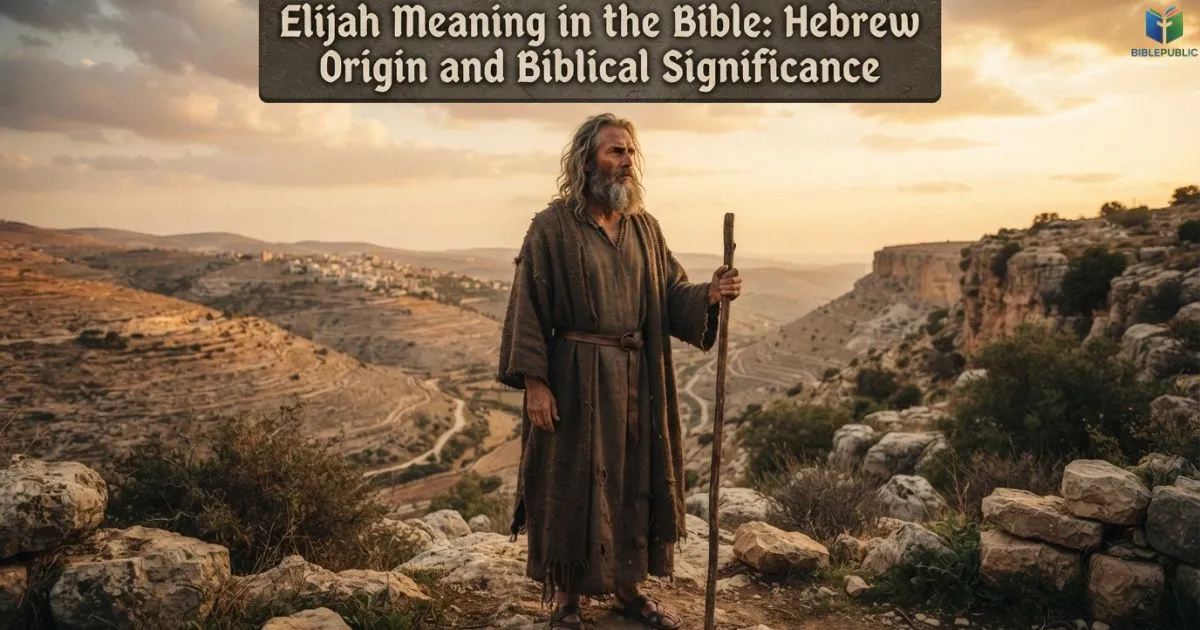
Elijah Meaning in the Bible reveals a powerful message about faith in God. The name means “My God is Yahweh” or “My God is the LORD.” Elijah was a prophet who stood firmly for his faith when many people in Israel turned to the worship of Baal.
In this guide, you will learn about Elijah’s Hebrew origin, his role as a prophet, and the key Bible stories that explain his significance. You will also discover what his life teaches about faith and obedience, along with why many Christian parents choose Elijah as a baby name.
What Does Elijah Mean in the Bible?
Elijah means “My God is Yahweh” or “My God is the LORD.” The name comes from Hebrew and expresses a declaration about the identity of God. In many English Bible translations, the divine name YHWH is represented by “LORD,” traditionally printed in capital letters.
This meaning is especially relevant to Elijah’s biblical story. During the reign of King Ahab, worship of Baal was a major religious issue in Israel. Elijah challenged this practice and called the people to recognize the LORD as God. In 1 Kings 18:21, he asks the Israelites how long they will waver between two opinions and urges them to decide whom they will follow.
The name therefore has a clear religious significance. It identifies the God of Israel and reflects the central question addressed throughout Elijah’s ministry: whom should the people worship? Readers exploring other biblical names may also find Noah’s meaning in the Bible helpful for understanding the meanings and stories connected with names in Scripture.
What Is the Hebrew Origin of the Name Elijah?
Elijah comes from the Hebrew name Eliyahu (אֵלִיָּהוּ). The name contains elements associated with God and the divine name Yahweh. It is commonly understood to mean “My God is Yahweh,” although some explanations express the meaning as “Yahweh is God.”
These English renderings communicate closely related ideas. The name refers specifically to the God of Israel rather than to a general or unspecified deity.
Understanding the Hebrew origin helps readers distinguish the name’s linguistic meaning from the religious lessons drawn from Elijah’s life. The name expresses a declaration about God, while the biblical narrative provides the context for understanding the prophet’s actions and message.
Elijah in Hebrew: Eliyahu
The Hebrew form of Elijah is Eliyahu, written אֵלִיָּהוּ. In English Bibles, this name is rendered Elijah. Related forms, including Elias, appear in different linguistic and biblical traditions.
The name is commonly explained through two principal elements: El, associated with God, and Yahu, a form connected with the divine name Yahweh. Together, these elements communicate the idea that the God of Israel is the one to whom the name refers.
The linguistic meaning should be distinguished from the qualities readers associate with Elijah. The name expresses a declaration about God, while courage, faithfulness, and prophetic authority are themes drawn from the biblical account of the man who bears it.
How the Hebrew Meaning Connects to God’s Name
In many English Bible translations, the Hebrew divine name YHWH is represented as LORD. Yahweh is a commonly used scholarly rendering of this name, although Jewish and Christian traditions differ in how they pronounce or refer to it.
This distinction helps explain why Elijah’s name appears in English as “My God is the LORD.” The word LORD in this rendering represents the divine name rather than a general title for any deity.
The name’s connection to God’s identity becomes particularly relevant in 1 Kings 18, when Elijah confronts the prophets of Baal on Mount Carmel. The passage centers on Israel’s divided allegiance and the question of whether the people will acknowledge the LORD as God.
Who Was Elijah in the Bible?
Elijah was an Old Testament prophet whose ministry is recorded primarily in 1 Kings 17–21 and 2 Kings 1–2. He served in the northern kingdom of Israel during the reign of King Ahab, whose rule the biblical narrative associates with the promotion of Baal worship.
Elijah delivered messages to the king, announced a drought, experienced God’s provision during hardship, confronted the prophets of Baal, and received further direction from God during a period of discouragement. His story presents both his public role as a prophet and his personal struggles.
Elijah also holds an important place in later biblical passages. The New Testament connects his prophetic role with John the Baptist and describes his appearance alongside Moses during the Transfiguration of Jesus.
Elijah the Prophet During King Ahab’s Reign
Elijah first appears prominently in 1 Kings 17:1, where he announces to King Ahab that there will be no dew or rain except according to his word. The drought becomes a major part of the conflict between the worship of the LORD and the religious practices associated with Baal.
First Kings 16:30–33 describes Ahab’s actions and his worship of Baal, establishing the background for Elijah’s prophetic ministry. Elijah’s message challenges the religious direction of the kingdom and calls the people to recognize the authority of the LORD.
In 1 Kings 18, Elijah gathers the people at Mount Carmel and challenges them to decide whom they will follow. The account describes the LORD answering Elijah’s prayer, after which the people acknowledge the LORD’s authority.
These events establish Elijah as a prophet who publicly confronts idolatry and calls Israel back to faithfulness. His role is not simply to perform miracles; it is to communicate God’s message during a period of religious conflict.
Elijah’s Mission and Message
Elijah’s mission centered on proclaiming the LORD’s authority and confronting practices that drew Israel away from worshiping Him. His prophetic work involved delivering warnings, speaking to rulers, praying for God’s intervention, and following the direction he received.
In 1 Kings 17, Elijah experiences God’s provision during the drought. In 1 Kings 18, he confronts the prophets of Baal. In 1 Kings 19, he becomes afraid for his life and deeply discouraged, yet God provides for him and gives him further instructions.
These accounts show different dimensions of Elijah’s ministry. He demonstrates courage when challenging wrongdoing, depends on God during uncertainty, and continues his calling despite personal distress.
His experience at Horeb also shows that the biblical account does not portray faithfulness as an absence of fear or exhaustion. Elijah receives care and renewed direction during a difficult period, providing important context for understanding the prophet beyond his most dramatic public confrontations.
How Does Elijah’s Name Connect to His Biblical Mission?
The meaning of Elijah’s name, “My God is Yahweh,” corresponds closely to the central message of his prophetic ministry. Throughout the biblical narrative, Elijah challenges the worship of Baal and calls Israel to recognize the LORD as God.
One of the clearest connections appears in 1 Kings 18:21, when Elijah asks the people how long they will waver between two opinions. His challenge concerns divided allegiance: if the LORD is God, the people should follow Him. The confrontation on Mount Carmel brings this question to the center of the story.
The relationship between the name and the prophet’s mission should be understood carefully. The Hebrew meaning is a linguistic explanation of the name, while its connection to Elijah’s ministry is an interpretation of the biblical narrative. The name does not independently establish every detail of Elijah’s character or actions.
Nevertheless, the connection is meaningful. Elijah’s name expresses a declaration about the LORD, and his prophetic work repeatedly calls Israel to acknowledge the same truth. This helps explain why the name is often associated with devotion to God, courage, and faithfulness.
What Are the Most Important Stories About Elijah in the Bible?

Elijah’s story includes God’s provision during a drought, the confrontation with the prophets of Baal, an encounter with God at Horeb, and his departure from earthly life in a whirlwind. These events appear mainly in 1 Kings 17–19 and 2 Kings 2.
Together, the accounts reveal different aspects of Elijah’s life and ministry. They describe God’s provision and authority while also showing the prophet’s vulnerability and need for continued guidance.
God Provides for Elijah During the Drought
In 1 Kings 17, Elijah announces a drought in Israel. God directs him to the brook Cherith, where he receives water and food brought by ravens. When the brook dries up, God sends him to Zarephath, where a widow provides for him.
The widow has very little food remaining, but she follows Elijah’s instructions. According to the account, her supply of flour and oil did not run out during the period of scarcity. Later, when her son becomes seriously ill and appears to die, Elijah prays to the LORD, and the child lives again (1 Kings 17:8–24).
These events demonstrate God’s provision within the biblical narrative. They also show that the account concerns more than Elijah’s personal needs: the widow and her son experience provision and restoration during a time of hardship.
For readers, the story can encourage reflection on trust and dependence on God. Its meaning, however, should remain grounded in the passage rather than being turned into a promise that every hardship will end in the same way.
Elijah’s Encounter with God at Horeb
After the confrontation on Mount Carmel, Elijah receives threats from Jezebel and flees for his life. In 1 Kings 19, he travels into the wilderness, becomes deeply discouraged, and asks God to take his life. God provides food and water, allowing him to continue his journey to Horeb, the mountain of God.
At Horeb, Elijah experiences a strong wind, an earthquake, and a fire. The narrative then describes a quiet encounter through which Elijah recognizes God’s presence. The King James Version of 1 Kings 19:12 uses the phrase “a still small voice,” while other English translations render the expression as “a gentle whisper” or “a low whisper.”
God speaks to Elijah, asks why he is there, gives him further instructions, and explains that seven thousand in Israel have not bowed to Baal (1 Kings 19:14–18).
This account adds an important dimension to Elijah’s story. Although he had demonstrated courage in public, he also experienced fear, loneliness, and exhaustion. God’s response includes provision, communication, and renewed direction.
The encounter at Horeb shows that Elijah’s ministry involved not only dramatic public signs but also receiving guidance after a period of discouragement.
Elijah Is Taken Up Into Heaven
In 2 Kings 2:1–12, Elijah travels with Elisha as the time of his departure approaches. Elisha repeatedly refuses to leave him, and the two continue their journey until they reach the Jordan River. Elijah strikes the water with his mantle, and they cross on dry ground.
Elijah asks Elisha what he can do for him before he is taken away. Elisha requests a double portion of Elijah’s spirit. As they continue speaking, a chariot of fire and horses of fire appear, and Elijah goes up by a whirlwind into heaven.
Elisha witnesses the event and cries out before taking up Elijah’s mantle. He then continues his prophetic ministry, marking a transition in leadership.
The passage describes Elijah’s extraordinary departure without presenting it as an ordinary death. It is an important part of his biblical story, but it should be distinguished from the linguistic meaning of his name.
What Does Elijah Teach Us About Faith and Obedience?
Elijah’s life offers lessons about faith, obedience, courage, and dependence on God. These lessons arise from specific biblical events rather than from the meaning of the name alone.
- Stand for faithfulness: In 1 Kings 18:20–39, Elijah challenges the worship of Baal and calls Israel to recognize the LORD. The account emphasizes his commitment to the message he has been given.
- Trust God during hardship: In 1 Kings 17, Elijah experiences God’s provision during the drought. The narrative portrays him relying on God’s direction when ordinary sources of food and water are uncertain.
- Recognize the reality of discouragement: In 1 Kings 19, Elijah becomes afraid and exhausted after facing opposition. His experience reminds readers that even a faithful servant can struggle and need support.
- Seek God’s direction: At Horeb, Elijah receives further guidance after the wind, earthquake, and fire. The passage emphasizes God’s communication with His prophet rather than promising that every difficult situation will be resolved through a dramatic sign.
- Continue faithfully through change: In 2 Kings 2, Elijah’s departure is followed by Elisha’s continuation of the prophetic work. The account highlights the transition from one prophet’s ministry to another.
These lessons should be read within their scriptural contexts. Elijah had a particular role in Israel’s history, so his experiences should not be turned into universal promises that every believer will experience the same events or outcomes.
His story nevertheless offers a meaningful example of devotion to God, courage in the face of opposition, and dependence on divine guidance during both public challenges and personal struggles. Readers interested in the meanings of other biblical names can also explore Ezra’s meaning in the Bible to learn about another figure from Scripture.
Where Is Elijah Mentioned in the New Testament?

Elijah appears in several important New Testament passages. His prophetic role is connected with John the Baptist, and he appears alongside Moses during the Transfiguration of Jesus. These references show Elijah’s continuing significance within the biblical story.
The passages should be read in their individual contexts. Some concern prophetic expectation and fulfillment, while others describe a specific event in Jesus’ ministry.
Elijah and John the Baptist
In Matthew 11:13–14, Jesus speaks about John the Baptist in connection with Elijah who was to come. Matthew 17:10–13 further explores this expectation as the disciples ask why the teachers of the law say Elijah must come first.
Luke 1:17 describes John as going before the Lord in the spirit and power of Elijah. This wording connects John’s mission with Elijah’s prophetic role rather than simply identifying John as the same individual as Elijah.
The connection is significant because John called people to repentance and prepared the way for Jesus’ ministry. Like Elijah, he challenged spiritual complacency and called people to respond to God’s message.
These passages connect John with the prophetic expectation associated with Elijah. Their theological meaning should be explained through the text and its context rather than through unsupported assumptions about reincarnation or the literal return of Elijah as John.
Elijah at the Transfiguration of Jesus
Elijah appears alongside Moses during the Transfiguration of Jesus, described in Matthew 17:1–13, Mark 9:2–13, and Luke 9:28–36. The disciples see Jesus transfigured, and Moses and Elijah appear speaking with Him.
Moses and Elijah are major figures in Israel’s Scriptures. Their appearance alongside Jesus places the event within the larger biblical story, while the Gospel accounts emphasize Jesus’ identity and the disciples’ experience of His glory.
In Matthew 17, the disciples also ask about the teaching that Elijah must come first. Jesus responds by referring to Elijah’s coming and explaining the suffering the Son of Man must experience. The passage connects prophetic expectation with Jesus’ mission.
Elijah’s appearance at the Transfiguration demonstrates his continuing importance within the New Testament. This event is distinct from the account of his departure in 2 Kings 2 and should be understood within the Gospel narrative.
Is Elijah a Good Biblical Name for a Baby?

Elijah can be a meaningful choice for parents seeking a biblical name connected with faith in God. Its commonly accepted meaning, “My God is Yahweh” or “My God is the LORD,” makes it especially relevant for families who value its connection to the God of Israel.
The name is associated with an important Old Testament prophet whose story includes faithfulness, courage, prayer, and obedience. Parents may appreciate these biblical associations while recognizing that a name’s meaning does not determine a child’s personality or future.
Elijah is the established English form of the Hebrew Eliyahu. Parents researching the name can consider its pronunciation, spelling, family traditions, and how it fits with a child’s full name. They may also encounter related forms such as Elias in different linguistic and biblical traditions. These forms should be researched in their own contexts rather than assumed to have identical histories in every language.
Before choosing Elijah, it can be helpful to read the passages describing the prophet’s life. This gives parents a better understanding of the name’s religious and historical context rather than relying only on a brief name-meaning definition.
Ultimately, Elijah is a strong option for families who want a name rooted in Scripture and associated with the declaration that the LORD is God. Its meaning and biblical history provide a thoughtful foundation for a naming decision, while the final choice remains personal to each family.
Conclusion
The Elijah Meaning in the Bible reveals a powerful message about faith in God. His name means “My God is Yahweh” or “My God is the LORD.” Through his courage, obedience, and prophetic mission, Elijah called Israel back to God. His experience at Horeb also shows how God provided guidance when the prophet felt afraid and discouraged.
If you are considering Elijah as a baby name, take time to read his story in 1 Kings 17–19 and 2 Kings 2. These passages offer a deeper understanding of his name, character, and biblical significance. Reflect on the message behind the name and how its meaning connects with your family’s faith, values, and hopes for your child.
Explore More Biblical Names and Their Meanings
Understanding Elijah’s Hebrew origin and biblical significance can help you explore how names express faith, identity, and God’s promises throughout Scripture. Reading about other biblical figures offers a broader view of their stories, the meaning behind their names, and the spiritual themes that connect their lives to the Bible’s larger message.
Levi Meaning in the Bible: Hebrew Origin and Biblical Significance
Asher Meaning in the Bible: Hebrew Origin and Biblical Significance
Biblical Meaning of Isaac: Faith, Covenant, and Promise
Frequently Asked Questions About Elijah
What does the name Elijah mean in the Bible?
Elijah means “My God is Yahweh” or “My God is the LORD.” Its Hebrew meaning expresses a declaration about the identity of the God of Israel and reflects the prophet’s central message.
What is the original Hebrew name for Elijah?
The original Hebrew name is Eliyahu (אֵלִיָּהוּ). It is commonly understood to mean “My God is Yahweh” and appears as Elijah in English Bible translations.
Who was Elijah, and why was he important in the Bible?
Elijah was a prophet in Israel during King Ahab’s reign. In 1 Kings 17–19, he confronts Baal worship, experiences God’s provision, and receives guidance during hardship.
Why did Elijah challenge the prophets of Baal on Mount Carmel?
Elijah challenged the prophets of Baal to confront Israel’s divided worship. In 1 Kings 18:21–39, he calls the people to choose whom they will follow, and the account describes God answering his prayer.
What does the Bible say happened when Elijah left earth?
Second Kings 2:11 describes Elijah going up into heaven in a whirlwind. The passage presents an extraordinary departure rather than an ordinary death, making this event a distinctive part of his biblical story.
Is Elijah a meaningful name for a Christian baby?
Elijah can be a meaningful biblical name for Christian families. Its connection to faith in God and the prophet’s story may appeal to parents who value Scripture and want a name with religious significance.

Chris Saadil is the founder of BiblePublic.com, where he shares biblical insights to help readers understand God’s Word and grow in faith. His mission is to make Scripture clear, practical, and encouraging through Bible verses, biblical teachings, prayer, and Christian living, helping believers build a deeper relationship with God every day.








2 thoughts on “Elijah Meaning in the Bible: Hebrew Origin and Biblical Significance”